Today's
EarthStation1.com 15% Off Commemorative Memorial Title: The
American Adventure: TV History Series 1607-1876 DVD MP4 USB Drive
Today, June 8, 2026
June 8: Thomas Paine Day (Freethinkers
Day): -- June 8, 1809: #DOTD: #RIP: Thomas Paine, English-American
political activist, philosopher, political theorist,
revolutionary, pamphleteer, author, possible Freemason, Founding
Father of the United States (b. February 9, 1737) #dies in the
morning at 59 Grove Street in Greenwich Village, New York City,
aged 72. Thomas Paine Day (Freethinkers Day) is observed on this
date in honor of his passing. Although the original building no
longer exists, the present building has a plaque noting that Paine
died at this location. His remains then went on a strange and, as
of 2023, unresolved journey. After his death, Paine's body was
brought to New Rochelle, but the Quakers would not allow it to be
buried in their graveyard as per his last will, so his remains
were buried under a walnut tree on his farm. In 1819, English
agrarian radical journalist William Cobbett, who in 1793 had
published a hostile continuation of Francis Oldys (George
Chalmer)'s The Life of Thomas Paine, dug up his bones and
transported them back to England with the intention to give Paine
a heroic reburial on his native soil, but this never came to pass.
The bones were still among Cobbett's effects when he died over
fifteen years later, but were later lost. There is no confirmed
story about what happened to them after that, although various
people have claimed throughout the years to own parts of Paine's
remains, such as his skull and right hand. He was taken care of at
the end of his life and buried by Marguerite Brazier, a Parisian
woman, the wife of author Nicholas Bonneville, and mother of
Paine's godson, the explorer Benjamin Bonneville. In his will,
Paine left the bulk of his estate to Marguerite, including 100
acres (40.5 ha) of his farm so she could maintain and educate
Benjamin and his brother Thomas. At the time of his death, most
American newspapers reprinted the obituary notice from the New
York Evening Post that was in turn quoting from The American
Citizen, which read in pAesthetics: Art: "He had lived long,
did some good, and much harm". Only six mourners came to his
funeral, as he had been ostracized for his ridicule of
Christianity and his attacks on the nation's leaders. Two of the
mourners were black, most likely freedmen. Months later, there
appeared a hostile biography by James Cheetham, who had admired
him since the latter's days as a young radical in Manchester, and
who had been friends with Paine for a short time before the two
fell out. Many years later the writer and orator Robert G.
Ingersoll wrote: "Thomas Paine had passed the legendary limit
of life. One by one most of his old friends and acquaintances had
deserted him. Maligned on every side, execrated, shunned and
abhorred - his virtues denounced as vices - his services forgotten
- his character blackened, he preserved the poise and balance of
his soul. He was a victim of the people, but his convictions
remained unshaken. He was still a soldier in the army of freedom,
and still tried to enlighten and civilize those who were
impatiently waiting for his death. Even those who loved their
enemies hated him, their friend - the friend of the whole world -
with all their hearts. On the 8th of June 1809, death came -
Death, almost his only friend. At his funeral no pomp, no
pageantry, no civic procession, no military display. In a
carriage, a woman and her son who had lived on the bounty of the
dead - on horseback, a Quaker, the humanity of whose heart
dominated the creed of his head - and, following on foot, two
negroes filled with gratitude - constituted the funeral cortege of
Thomas Paine." Thomas Paine was #born Thomas Pain on January
29, 1737 O.S. (February 9, 1737 N.S.) in Thetford, England. Paine
emigrated to the British American colonies in 1774 with the help
of Benjamin Franklin, arriving just in time to participate in the
American Revolution. He authored two of the most influential
pamphlets at the start of the American Revolution - Common Sense
(1776) and The American Crisis (1776-1783), the latter which began
"These are the times that try men's souls" - which
provided inspiration to undecided Americans that a new nation,
independent from Britain, might eventually become "...an
asylum for mankind!", and he helped to inspire the Patriots
in 1776 to declare independence from Great Britain. Virtually
every American Patriot read his 47-page pamphlet Common Sense,
which catalyzed the call for independence from Great Britain. The
American Crisis was a pro-independence pamphlet series. His ideas
reflected Enlightenment-era ideals of human rights. He served in
the Continental Army and observed the hardships of American troops
fighting the world's most powerful army. He refused to accept the
profits from his writings and wound up destitute after the
Revolution. Paine lived in France for most of the 1790s, becoming
deeply involved in the French Revolution. While in England, he
wrote Rights of Man (1791), in part a defense of the French
Revolution against its critics. His attacks on Anglo-Irish
conservative writer Edmund Burke led to a trial and conviction in
absentia in England in 1792 for the crime of seditious libel. The
British government of William Pitt the Younger was worried by the
possibility that the French Revolution might spread to Britain and
had begun suppressing works that espoused radical philosophies.
Paine's work advocated the right of the people to overthrow their
government and was therefore targeted with a writ for his arrest
issued in early 1792. Paine fled to France in September, despite
not being able to speak French, but he was quickly elected to the
French National Convention. The Girondins regarded him as an ally;
consequently, the Montagnards regarded him as an enemy, especially
Maximilien Robespierre. In December 1793, he was arrested and was
taken to Luxembourg Prison in Paris. While in prison, he continued
to work on The Age of Reason (1793-1794). James Monroe used his
diplomatic connections to get Paine released in November 1794.
Paine became notorious because of his pamphlets and attacks on his
former allies, who he felt had betrayed him. In The Age of Reason
and other writings, he advocated Deism, promoted reason and
freethought, and argued against religion in general and Christian
doctrine in particular. In 1796, he published a bitter open letter
to George Washington, whom he denounced as an incompetent general
and a hypocrite. He published the pamphlet Agrarian Justice
(1797), discussing the origins of property and introducing the
concept of a guaranteed minimum income through a one-time
inheritance tax on landowners. In 1802, he returned to the U.S.,
where he died seven years later. Though there is no definitive
evidence Paine himself was a Freemason, upon his return to America
from France he penned "An Essay on the Origin of
Free-Masonry" (1803-1805) about Freemasonry being derived
from the religion of the ancient Druids. Marguerite de Bonneville
published the essay in 1810 after Paine's death, but she chose to
omit certain passages from it that were critical of Christianity,
most of which were restored in an 1818 printing. In the essay,
Paine stated that "the Christian religion is a parody on the
worship of the Sun, in which they put a man whom they call Christ,
in the place of the Sun, and pay him the same adoration which was
originally paid to the Sun." Paine also had a negative
attitude toward Judaism. While never describing himself as a
Deist, he openly advocated Deism in his writings, and called Deism
"the only true religion": "The opinions I have
advanced ... are the effect of the most clear and long-established
conviction that the Bible and the Testament are impositions upon
the world, that the fall of man, the account of Jesus Christ being
the Son of God, and of his dying to appease the wrath of God, and
of salvation, by that strange means, are all fabulous inventions,
dishonorable to the wisdom and power of the Almighty; that the
only true religion is Deism, by which I then meant, and mean now,
the belief of one God, and an imitation of his moral character, or
the practice of what are called moral virtues - and that it was
upon this only (so far as religion is concerned) that I rested all
my hopes of happiness hereafter. So say I now - and so help me
God." National Carnation Day was established in his honor as
he always wore a red carnation on his lapel. The carnation was
said to be his favorite flower, and he always wore one for good
luck. According to legend, when President McKinley was shot by an
assassin's bullet in September of 1901, it was just after he took
off the carnation he was wearing and gave it to a young girl.
People believe luck left him when he took off the carnation. After
his death, National Carnation Day started in his honor. On Sale @
15% Off Discount Till Midnight PT!
https://store.earthstation1.com/the-american-adventure-series-us-1st-century-4-dv14.html
Today's
EarthStation1.com 15% Off Commemorative Memorial Title: Attack On
The Liberty USS Liberty Incident DVD, Download, USB Drive
Today, June 8, 2026
June 8: USS Liberty Remembrance Day: --
June 8, 1967: The Cold War: The Arab Cold War (July 23, 1952 -
February 11, 1979): The Arab-Israeli Conflict: The
Israeli-Palestinian Conflict: The Six-Day War ((Hebrew: Milhemet
Seset HaYamim; Arabic: An-Naksah, "The Setback", Harb
1967, "The War Of 1967") (The June War, The 1967
Arab-Israeli War, The Third Arab-Israeli War): The USS Liberty
Incident: -- The United States Navy technical research ship USS
Liberty is attacked in international waters by Israeli Air Force
jet fighter aircraft and Israeli Navy motor torpedo boats during
the Six-Day War. The combined air and sea attack killed 34 crew
members (naval officers, seamen, two marines, and one civilian),
wounded 171 crew members, and severely damaged the ship. Israel
apologized for the attack, saying that the USS Liberty had been
attacked in error after being mistaken for an Egyptian ship. At
the time, the ship was in international waters north of the Sinai
Peninsula, about 25.5 nautical miles northwest from the Egyptian
city of Arish. Officailly, both the Israeli and U.S. governments
conducted inquiries and issued reports that concluded the attack
was a mistake due to Israeli confusion about the ship's identity;
however, at the time, evidence and the testimony of the survivors
of the attack as well as Israeli radar and communication signals
data clearly showed that the attack upon the clearly-marked US
Navy ship was deliberate as the Israelis suspected that the ship
was covertly providing Egypt with military intelligence, a likely
assertion. In May 1968, the Israeli government made payment to the
U.S. government in compensation to the families of the 34 men
killed in the attack. In March 1969, Israel made a furthur payment
to the men who had been wounded. In December 1980, Israel agreed
to make a payment as the final settlement for material damage to
Liberty, itself plus 13 years of interest. On Sale @ 15% Off
Discount Till Midnight PT!
https://store.earthstation1.com/attack-on-the-liberty-dvd-six-day-war-documentary.html
Today's
EarthStation1.com 15% Off Commemorative Memorial Title: The Great
Polynesian Navigators Of The Pacific DVD, MP4, USB Drive
Today, June 8, 2026
June 8: World Oceans Day: -- A day
coordinated by The Ocean Project concerning this crucial
environmental issue. We get both foods and medicines from the deep
blue, and it helps to keep the climate in check. The ocean is also
the "lungs of the earth" - as it turns out, the majority
of oxygen we breathe comes from the ocean. We always felt that the
waves breathed some life into us. (Alright, once or twice it was
the lifeguard, but that doesn't diminish the worth of one our most
valuable resources.) However, if we don't take the steps to
conserve it, we'll lose a lot more than a spot for a weekend
getaway. So dive in and do your part to keep big blue going
strong. For many people, the beach spells fun in the sun. While
taking a dip feels great, we sometimes don't think about what that
water really means to us. It's essential to the biosphere and we
want to make sure that future generations get to enjoy it. Chances
are, the creatures that live there will also appreciate it (there
are over 1 million of them!). And when you look out into the
distance and see ships going to who knows where, it's a strong
reminder that we're all connected. So much of our waste isn't
biodegradable, and the ocean is left cleaning up our mess. Dumping
recyclables into the proper bin is a good first step, but we have
to carry that habit back home. Even if you don't live near the
coast, let your friends and family know how recycling puts a big
smile on the ocean's face. We never need an excuse to go to the
beach, but we'll gladly take one. At times, we just have to pinch
ourselves at how gorgeous the place can be; a sunset reflected on
the water is like something out of a painting. Most importantly,
the ocean gives us the perfect opportunity to empty our heads and
relax. Some moments speak for themselves so we don't have to. It's
not like the squawking seagulls would let us get a word in anyway.
On Sale @ 15% Off Discount Till Midnight PT!
https://store.earthstation1.com/the-great-polynesian-navigators-of-the-pacific-dvd-mp3-us3.html
Today's
EarthStation1.com 15% Off Commemorative Memorial Title: Damn The
Defiant! H.M.S. Defiant 1962 RN Alec Guinness DVD MP4 USB
Today, June 8, 2026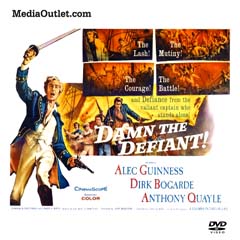
June 8: Bounty Day (Anniversary Day)
(Australia): -- On June 8, 1856, a group of 194 Pitcairn
Islanders, descendants of the mutineers of HMS Bounty, arrived at
Norfolk Island on their ship Morayshire, commencing the Third
Settlement of the Island. On June 8, Bounty Day celebrates this
event, observed by the people of Norfolk Island, an external
territory of Australia located in the Pacific Ocean between New
Zealand and New Caledonia, with a re-enactment of the mutiny along
with wreathe-laying, parades, singing of hymns, and a picnic with
traditional food. The Pitcairners are descendants of the English
sailors and the Tahitian women who began a new life on Pitcairn
Island under the leadership of Fletcher Christian. In 1856, Queen
Victoria gave Norfolk Island to the expanding Pitcairn community.
Pitcairn Island, the original island of the Islanders of Norfolk,
has a fascinating story. In 1787, Lieutenant William Bligh set
sail in the HMS Bounty to Tahiti to gather breadfruit plants for
Caribbean slave colonies. A lot of disputes took place during the
journey. Finally, Fletcher Christian and some of the crewmembers
staged a mutiny. This very mutiny is re-enacted by the people of
Norfolk on Bounty Day. The mutineers captured the Bounty and set
Lieutenant Bligh and his followers adrift to reach the Dutch East
Indies, north of Australia. The mutineers eventually found the
island of Pitcairn by 1790 and they were welcomed by Mr. and Mrs.
Stewart, who were settled there. By the 1850s, their population
had grown significantly and they needed a larger place to settle.
Finally, when the people of Pitcairn asked the British Government
for a larger home, Queen Victoria gave them Norfolk Island. And by
the time they resettled there, the Pitcairners had already formed
their own culture and language, both of which are still alive to
this day. On Bounty Day, the descendants of the original Norfolk
settlers stage a re-enactment of the mutiny along with a parade,
and they lay wreaths on the graves of the dead and more. On Sale @
15% Off Discount Till Midnight PT!
https://store.earthstation1.com/damn-the-defiant-alec-guinness-napoleonic-british-naval-dvd.html
Today's
EarthStation1.com 15% Off Commemorative Memorial Title: Attila The
Hun 2 Part Documentary Series DVD MP4 Video Download
Today, June 8, 2026
June 8, 452: The Huns: The Hunnic
Invasions: The Hunnic Invasion Of Italy: -- Attila leads a Hun
army in the invasion of Italy, devastating the northern provinces
as he heads for Rome. Attila had returned to Italy to renew his
marriage claim with Honoria, sister of the Roman Emperor
Valentinian III, who had sent the Hunnish king a plea for help -
and her engagement ring - in order to escape her forced betrothal
to a Roman senator in the spring of 450. Honoria may not have
intended a proposal of marriage, but Attila chose to interpret her
message as such. He accepted, asking for half of the western
Empire as dowry. When Valentinian discovered the plan, only the
influence of his mother Galla Placidia convinced him to exile
Honoria, rather than killing her. He also wrote to Attila,
strenuously denying the legitimacy of the supposed marriage
proposal. Attila sent an emissary to Ravenna to proclaim that
Honoria was innocent, that the proposal had been legitimate, and
that he would come to claim what was rightfully his. As Attila
invaded and ravaged Italy, communities became established in what
would later become Venice as a result of these attacks, when the
residents fled to small islands in the Venetian Lagoon. His army
sacked numerous cities and razed Aquileia so completely that it
was afterwards hard to recognize its original site. Roman general
Flavius Aetius, who had in the past been on good terms with
Attila, led the battle against him, but lacked the strength to
offer effective opposition, though he managed to harass and slow
Attila's advance with only a shadow force. Attila finally halted
at the River Po. However, by this point, disease and starvation
had taken hold in Attila's camp, hindering his war efforts and
ultimately bringing about the cessation of invasion. Despite this
state of affairs, Emperor Valentinian III, who did not know the
dire state of Attila's forces, sent three envoys, the high
civilian officers Gennadius Avienus and Trigetius, as well as the
Bishop of Rome Leo I, to meet Attila at Mincio in the vicinity of
Mantua to buy off Attila with gold, and thereby obtain from him
the promise that he would withdraw from Italy and negotiate peace
with the Emperor. Prosper of Aquitaine gives a short description
of the historic meeting, but gives all the credit to Leo for the
successful negotiation. Priscus reports that superstitious fear of
the fate of Alaric gave Attila pause to think, as Alaric died
shortly after sacking Rome in 410 - pause that ultimately proved
valid, as Attila died some nine months later. As Italy had
suffered from a terrible famine in 451, and her crops were faring
little better in 452, Attila's devastating invasion of the plains
of northern Italy this year did not improve the harvest. To
advance on Rome would have required supplies which were not
available in Italy, and taking the city would not have improved
Attila's supply situation. Therefore, it was more profitable for
Attila to take the gold, conclude peace and retreat to his
homeland. Nevertheless, this did not prevent Attila from
conducting The Sack Of Aquileia, an ancient Roman city in Italy at
the head of the Adriatic Sea, on July 18, 452 during his retreat.
On Sale @ 15% Off Discount Till Midnight PT!
https://store.earthstation1.com/attila-the-hun-2-part-documentary-series-dvd-mp4-video-downlo24.html
Today's
EarthStation1.com 15% Off Commemorative Memorial Title: The
Vikings: A Documentary History MP4 Video Download DVD
Today, June 8, 2026
June 8, 793: The Vikings: Viking
Expansion: Viking Activity In The British Isles: The Viking Age
(793-1066 CE): -- The Viking Age begins as a Viking raiding party
sacks the Anglo-Saxon abbey at Lindisfarne, an island off
England's eastern coast in Northumbria, commonly accepted as the
first date-and-year documented Norse activity in the British
Isles. The first known account of a Viking raid in Anglo-Saxon
England comes from 789, when three ships from Hordaland (in modern
Norway) landed in the Isle of Portland on the southern coast of
Wessex. They were approached by Beaduheard, the royal reeve from
Dorchester, whose job it was to identify all foreign merchants
entering the kingdom, and they proceeded to kill him. There were
almost certainly unrecorded earlier raids. In a document dating to
792, King Offa of Mercia set out privileges granted to monasteries
and churches in Kent, but he excluded military service "against
seaborne pirates with migrating fleets", showing that Viking
raids were already an established problem. In a letter of 790-92
to King AEthelred I of Northumbria, Alcuin berated English people
for copying the fashions of pagans who menaced them with terror.
This shows that there were already close contacts between the two
peoples, and the Vikings would have been well informed about their
targets. The following year, they sacked the nearby
Monkwearmouth-Jarrow Abbey. In 795, they once again attacked, this
time raiding Iona Abbey off Scotland's west coast. This monastery
was attacked again in 802 and 806, when 68 people living there
were killed. After this devastation, the monastic community at
Iona abandoned the site and fled to Kells in Ireland. In the first
decade of the ninth century, Viking raiders began to attack
coastal districts of Ireland. In 835, the first major Viking raid
in southern England took place and was directed against the Isle
of Sheppey. On Sale @ 15% Off Discount Till Midnight PT!
https://store.earthstation1.com/the-vikings-a-documentary-history-mp4-video-download-dv4.html
Today's
EarthStation1.com 15% Off Commemorative Memorial Title: Portraits
Of American Presidents Nos. 1-42 TV Series MP4 Download DVD
Today, June 8, 2026
June 8, 1789: The United States: The
History Of The United States: The Constitution Of The United
States: The United States Bill Of Rights: -- U.S. House
Representative From Virginia James Madison, future 4th POTUS,
introduces twelve proposed amendments to the United States
Constitution at The 1st United States Congress (March 4, 1789, to
March 4, 1791). These proposed amendments resulted in The Bill Of
Rights, the first ten amendments to the United States
Constitution. Largely because of the efforts of Representative
James Madison, who studied the deficiencies of the Constitution
pointed out by anti-federalists and then crafted a series these
twelve proposals corrective proposals, Congress approved these
amendments on September 25, 1789, and submitted them to the states
for ratification. Contrary to Madison's proposal that the proposed
amendments be incorporated into the main body of the Constitution
(at the relevant articles and sections of the document), they were
proposed as supplemental additions (codicils) to it. Articles
Three through Twelve were ratified as additions to the
Constitution on December 15, 1791, and became Amendments One
through Ten of the Constitution. Article Two became part of the
Constitution on May 5, 1992, as the Twenty-seventh Amendment.
Article One, The Congressional Apportionment Amendment, which
addresses the number of seats in the House of Representatives, is
still pending before the states. Although Madison's proposed
amendments included a provision to extend the protection of some
of the Bill of Rights to the states, the amendments that were
finally submitted for ratification applied only to the federal
government. The door for their application upon state governments
was opened in the 1860s, following ratification of the Fourteenth
Amendment. Since the early 20th century both federal and state
courts have used the Fourteenth Amendment to apply portions of the
Bill of Rights to state and local governments. The process is
known as incorporation. On Sale @ 15% Off Discount Till Midnight
PT!
https://store.earthstation1.com/portraits-of-american-presidents-nos-142-tv-series-mp4-download1424.html
Today's
EarthStation1.com 15% Off Commemorative Memorial Title: The French
Revolution Series + Irish Rebellion & You Are There MP4 DVD
Today, June 8, 2026
June 8, 1794: The Age Of Enlightenment
(The Enlightenment, The Age Of Reason): The Age Of Revolution: The
Atlantic Revolutions: The French Revolution: The French First
Republic (French: Premiere Republique; Revolutionary France,
Officially The French Republic [French: Republique Francaise]):
The National Convention (French: Convention Nationale): The Cult
Of The Supreme Being (French: Culte De L'Etre Supreme): --
Maximilien Robespierre inaugurates the French Revolution's new
state religion, the Cult of the Supreme Being, with large
organized festivals all across France. On May 7, 1794, Robespierre
introduced the Cult of the Supreme Being in the National
Convention as the new state religion of the French First Republic.
The Cult of the Supreme Being was a form of deism intended as a
replacement for Roman Catholicism and its rival, the Cult of
Reason, France's first established state sponsored atheistic
religion. Robespierre believed that reason is only a means to an
end, and the singular end is virtue. He sought to move beyond
simple deism (often described as Voltairean by its adherents) to a
new and, in his view, more rational devotion to the godhead. The
primary principles of the Cult of the Supreme Being were a belief
in the existence of a god and the immortality of the human soul.
Though not inconsistent with Christian doctrine, these beliefs
were put to the service of Robespierre's fuller meaning, which was
of a type of civic-minded, public virtue he attributed to the
Greeks and Romans. This type of virtue could only be attained
through active fidelity to liberty and democracy.] Belief in a
living god and a higher moral code, he said, were "constant
reminders of justice" and thus essential to a republican
society. To inaugurate the new state religion, Robespierre
declared that 20 Prairial Year II (8 June 1794) would be the first
day of national celebration of the Supreme Being, and future
republican holidays were to be held every tenth day, the days of
rest (decadi) in the new French Republican Calendar. Every
locality was mandated to hold a commemorative event, but the event
in Paris was designed on a massive scale. The festival was
organized by the artist Jacques-Louis David and took place around
a man-made mountain on the Champ de Mars. Robespierre assumed full
leadership of the event, forcefully, and, to many, ostentatiously,
declaring the truth and "social utility" of his new
religion. The Cult of the Supreme Being and its festival may have
contributed to the Thermidorian Reaction (On 9 Thermidor Year II
[27 July 1794], Robespierre was denounced by members of the
National Convention as "a tyrant", leading to
Robespierre and twenty-one associates including Louis Antoine de
Saint-Just being arrested that night and beheaded on the following
day). With Robespiere's execution by guillotine on 28 July 1794,
the cult lost all official sanction, and disappeared from public
view. It was officially banned by Napoleon Bonaparte on April 8,
1802 with his Law On Cults of 18 Germinal, Year X. On Sale @ 15%
Off Discount Till Midnight PT!
https://store.earthstation1.com/the-french-revolution-dvd-3-part-tv-documentary-serie3.html
Today's
EarthStation1.com 15% Off Commemorative Memorial Title: Music
Documentaries IV Moods & Music Code & Cypher MP4 DVD USB
Today, June 8, 2026
June 8, 1810: #BOTD: #HBD! Robert
Schumann, German composer and an influential music critic (d. July
29, 1856) is #born in Zwickau, Kingdom of Saxony (today Central
Germany). He is widely regarded as one of the greatest composers
of the Romantic era. Schumann left the study of law, intending to
pursue a career as a virtuoso pianist. He had been assured by his
teacher Friedrich Wieck, a German pianist, that he could become
the finest pianist in Europe, but a hand injury ended this dream.
Schumann then focused his musical energies on composing.
Schumann's published compositions were written exclusively for the
piano until 1840; he later composed works for piano and orchestra;
many Lieder (songs for voice and piano); four symphonies; one
opera; and other orchestral, choral, and chamber works. Works such
as Carnaval, Symphonic Studies, Kinderszenen, Kreisleriana, and
the Fantasie in C are among his most famous. His writings about
music appeared mostly in the Neue Zeitschrift fur Musik (New
Journal for Music), a Leipzig-based publication which he jointly
founded. In 1840, Schumann married Friedrich Wieck's daughter
Clara, against the wishes of her father, following a long and
acrimonious legal battle, which found in favor of Clara and
Robert. Clara also composed music and had a considerable concert
career as a pianist, the earnings from which, before her marriage,
formed a substantial part of her father's fortune. Robert Schumann
died in Bonn, Rhine Province, Prussia, aged 46, most likely caused
by syphilis. His medical records from this illness were released
in 1991, and suggest a "progressive paralysis", a term
used for neurosyphilis at the time, although a diagnostic test for
the Treponema pallidum syphilis bacterium did not become available
until 1906. These records and his reported symptoms have
contributed to a modern view is that he did indeed die from
syphilis, which he could have contracted during his student days,
and which could have remained latent during most of his marriage.
According to studies by the musicologist and literary scholar Eric
Sams, Schumann's symptoms during his terminal illness and death
appear consistent with those of mercury poisoning; mercury was a
common treatment for syphilis and other conditions. Another
possibility is that his neurological problems were a result of an
intracranial mass. A report by Janisch and Nauhaus on Schumann's
autopsy indicates that he had a "gelatinous" tumor at
the base of the brain; it may have represented a colloid cyst, a
craniopharyngioma, a chordoma, or a chordoid meningioma. In
particular, meningiomas are known to produce musical auditory
hallucinations such as Schumann reported; Schumann heard a
persistent A-note at the end of his life, which may have been a
form of tinnitus, or perhaps an auditory hallucination caused by
meningioma or to his major depressive episode. At times, he had
musical hallucinations that were longer than just the single A,
but his diaries include comments about hearing the annoying single
note. Schumann suffered from a mental disorder, first manifesting
itself in 1833 as a severe melancholic depressive episode, which
recurred several times alternating with phases of 'exaltation' and
increasingly also delusional ideas of being poisoned or threatened
with metallic items. Diagnosed with "psychotic melancholia",
Schumann's symptoms increased in late February 1854, with angelic
visions sometimes being replaced by demonic ones. He warned his
wife Clara that he feared he might do her harm. On February 27, he
attempted suicide by throwing himself from a bridge into the Rhine
River (his elder sister Emilie had died by suicide in 1825,
possibly by drowning herself). Rescued by boatmen and taken home,
he asked to be taken to an asylum for the insane. He entered Dr.
Franz Richarz's sanatorium in Endenich, a quarter of Bonn, and
remained there until he died. During his confinement, he was not
allowed to see Clara, although Brahms was free to visit him. Clara
finally visited him two days before his death. He appeared to
recognize her, but was able to speak only a few words. After
Robert's death, Clara continued her career as a concert pianist,
which supported the family. From mid-career on, she mainly
performed music by leading composers. A hired cook and housekeeper
tended to the children while she traveled. In 1856, she first
visited England. The critics received Robert's music coolly, with
Henry Chorley being particularly harsh. She returned to London in
1865 and made regular appearances there in later years, often
performing chamber music with the violinist Joseph Joachim and
others. She became the authoritative editor of her husband's works
for Breitkopf & Hartel. It was rumoured that she and Brahms
destroyed many of Schumann's later works, which they thought were
tainted by his madness, but only the Five Pieces for Cello and
Piano are known to have been destroyed. Most of Schumann's late
works, particularly the Violin Concerto, the Fantasy for Violin
and Orchestra and the Violin Sonata No. 3, all from 1853, have
entered the repertoire. On Sale @ 15% Off Discount Till Midnight
PT!
https://store.earthstation1.com/music-documentaries-iv-dvd-moods-amp-music-code-amp-cypher.html
Today's
EarthStation1.com 15% Off Commemorative Memorial Title: Lincoln
And The War Within: Election To Ft. Sumter DVD, MP4, USB Drive
Today, June 8, 2026
June 8, 1861: The American Civil War (The
Civil War, The War Between The States): The Secession Of The
Southern States Of America: The Secession Of Tennessee From The
United States Of America: -- In reaction to Abraham Lincoln's call
to provide troops from the "militia of the several states"
to put down the rebellion of secessionist states against the
Union, Tennessee becomes the tenth state to secede from the Union.
The title of "last to join the Confederacy" is a
problematic one; although Tennessee's informal secession on May 7,
1861 preceded North Carolina's official secession on May 20, the
Tennessee legislature did not formally vote to secede until June
8, 1861; nevertheless, in effect, Tennessee is considered to be
the 10th state to secede, followed by North Carolina. In February
1861, secessionists in Tennessee's state government led by
Governor Isham Harris sought voter approval for a convention to
sever ties with the United States, but Tennessee voters rejected
the referendum by a 54-46% margin. The strongest opposition to
secession came from East Tennessee, which later tried to form a
separate Union-aligned state. Following the Confederate attack
upon Fort Sumter in April and Lincoln's call for troops from
Tennessee and other states in response, Governor Isham Harris
began military mobilization, submitted an ordinance of secession
to the General Assembly, and made direct overtures to the
Confederate government. The Tennessee legislature ratified an
agreement to enter a military league with the Confederate States
on May 7, 1861. On June 8, 1861, with people in Middle Tennessee
having significantly changed their position, voters approved a
second referendum calling for secession, becoming the last state
to do so. On March 4, 1861, Lincoln was sworn in as President. In
his inaugural address, he argued that the Constitution was a "more
perfect union" than the earlier Articles Of Confederation and
Perpetual Union, that it was a binding contract, and called any
secession "legally void". He stated he had no intent to
invade the Southern states, nor did he intend to end slavery where
it existed, but that he would use force to maintain possession of
federal property belonging to the United States. His speech closed
with a plea for restoration of the bonds of union. By 1856, the
South had lost control of Congress, and was no longer able to
silence calls for an end to slavery, which came mostly from the
more populated, free states of the North. The Republican Party,
founded in 1854, pledged to stop the spread of slavery beyond
those states where it already existed. After Abraham Lincoln was
elected the first Republican president in 1860, seven cotton
states - South Carolina, Mississippi, Florida, Alabama, Georgia,
Louisiana and Texas respectively - declared their secession and
formed the Confederate States of America before Lincoln was
inaugurated. The United States government, both outgoing and
incoming, refused to recognize the Confederacy, and when the new
Confederate President Jefferson Davis ordered his troops to open
fire on Fort Sumter in April 1861, there was an overwhelming
demand, North and South, for war. Only the state of Kentucky
attempted to remain neutral, and it could only do so briefly, and
chose to remain in the Union. When Lincoln called for troops to
suppress what he referred to as "combinations too powerful to
be suppressed by the ordinary" judicial or martial means,
four more states - Virginia, Arkansas, Tennessee and North
Carolina - decided to secede and join the Confederacy, which then
moved its capital to Richmond, Virginia. Residents of the western
counties of Virginia did not wish to secede along with the rest of
the state. This section of Virginia was admitted into the Union as
the state of West Virginia on June 20, 1863. Four slave states
decided to stay in the Union: Delaware, Kentucky, Maryland, and
Missouri. Although divided in their loyalties, a combination of
political maneuvering and Union military pressure kept these
states from seceding. On Sale @ 15% Off Discount Till Midnight PT!
https://store.earthstation1.com/lincoln-and-the-war-within-election-to-sumter-dvd-mp4-us4.html
Today's
EarthStation1.com 15% Off Commemorative Memorial Title: Frank
Lloyd Wright Documentaries DVD, Video Download, USB Flash Drive
Today, June 8, 2026
June 8, 1867: #BOTD: #HBD! Frank Lloyd
Wright, American architect, designer, writer, and educator (d.
April 9, 1959) is #born in the town of Richland Center, Wisconsin.
He designed more than 1,000 structures over a creative period of
70 years. Wright believed in designing in harmony with humanity
and the environment, a philosophy he called organic architecture.
This philosophy was exemplified in Fallingwater (1935), which has
been called "the best all-time work of American
architecture". Wright played a key role in the architectural
movements of the twentieth century, influencing architects
worldwide through his works and hundreds of apprentices in his
Taliesin Fellowship. Wright was the pioneer of what came to be
called the Prairie School movement of architecture and also
developed the concept of the Usonian home in Broadacre City, his
vision for urban planning in the United States. He also designed
original and innovative offices, churches, schools, skyscrapers,
hotels, museums, and other commercial projects. Wright-designed
interior elements (including leaded glass windows, floors,
furniture and even tableware) were integrated into these
structures. He wrote several books and numerous articles and was a
popular lecturer in the United States and in Europe. Wright was
recognized in 1991 by the American Institute of Architects as "the
greatest American architect of all time". In 2019, a
selection of his work became a listed World Heritage Site as The
20th-Century Architecture of Frank Lloyd Wright. Raised in rural
Wisconsin, Wright studied civil engineering at the University of
Wisconsin and then apprenticed in Chicago, first with Joseph Lyman
Silsbee (1887) and then with Louis Sullivan (1888). He opened his
own successful Chicago practice in 1893 and established a studio
in his Oak Park, Illinois home in 1898. His personal life made
headlines: leaving his first wife, Catherine Tobin, for Mamah
Cheney in 1909; the murders at his Taliesin estate by a staff
member in 1914; his tempestuous marriage with second wife Miriam
Noel in 1923; and his relationship with Olgivanna Lazovic, whom he
married in 1928. Frank Lloyd Wright died of natural causes at the
age 91 in a Phoenix, Arizona hospital. The body was returned to
his 1,600 acre estate at Spring Green, Wisconsin. After a service,
a horse and wagon carried his body from Unity Chapel to where the
graves of many members of the Wright family (his mother, his
mistress Mamah and her two children) are interred. His first wife,
Kitty had died at age 92 a few weeks before. However, after the
death of Olgivanna Wright his last wife, his body was disinterred,
his remains cremated and his ashes mixed with Olgivanna's and then
divided: some spread over the Arizona desert and the rest interred
on the Wright estate. His cenotaph (a marker within a cemetery
placed in honor of a person whose remains are elsewhere) is at The
Taliesin West Burial Site in Scottsdale, Arizona. He once wrote,
"No house should ever be on any hill or on anything. It
should be of the hill, belonging to it, so hill and house could
live together each the happier for the other." On Sale @ 15%
Off Discount Till Midnight PT!
https://store.earthstation1.com/frank-lloyd-wright-documentaries-dvd.html
Today's
EarthStation1.com 15% Off Commemorative Memorial Title: The
Machine That Changed The World: The Computer DVD MP4 Download
Today, June 8, 2026
June 8, 1887: The Industrial Revolution:
The Third Industrial Revolution (1947-Present) (The Information
Age, The Computer Age, The Digital Age, The Digital Electronics
Revolution, The Silicon Age, The New Media Age, The Media Age):
The Computer: The History Of The Computer: Digital Computers: --
Herman Hollerith applies for US patent #395,781 for the 'Art Of
Compiling Statistics', which was his punched card calculator. A
punched card (also punch card or punched-card) is a piece of stiff
paper that holds digital data represented by the presence or
absence of holes in predefined positions. Punched cards were once
common in computing for data processing applications or to
directly control automated machinery. Punched cards were widely
used through much of the 20th century in the data processing
industry, where specialized and increasingly complex unit record
machines, organized into semiautomatic data processing systems,
used punched cards for data input, output, and storage. The IBM
12-row/80-column punched card format came to dominate the
industry. Many early digital computers used punched cards as the
primary medium for input of both computer programs and data. While
punched cards are now obsolete as a storage medium, as of 2012,
some voting machines still used punched cards to record votes.
They also had a significant cultural impact. On Sale @ 15% Off
Discount Till Midnight PT!
https://store.earthstation1.com/the-machine-that-changed-the-world-the-computer-dvd-mp4-downloa4.html
Today's
EarthStation1.com 15% Off Commemorative Memorial Title: T.R.: The
Life Of Theodore Roosevelt DVD, Video Download, USB Drive
Today, June 8, 2026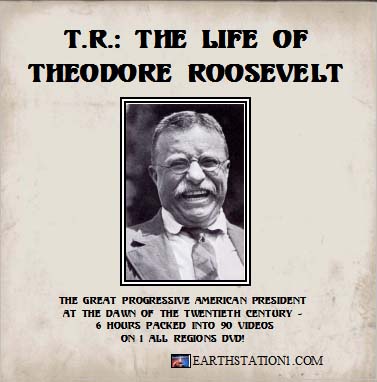
June 8, 1906: The Environment: The
Progressive Era In The United States: United States Federal
Environmental Legislation: United States Federal Public Land
Legislation: The Antiquities Act (The Antiquities Act Of 1906): --
In order to restrict the use of parcels of public land deemed by
The President Of The United States to have historical or
conservation value, President Theodore Roosevelt signs the
Antiquities Act Of 1906 into law. The Antiquities Act of 1906
gives the President the authority by presidential proclamation to
create national monuments from federal lands to protect
significant natural, cultural, or scientific features. The Act has
been used more than a hundred times since its passage. The
Antiquities Act was signed into law by President Theodore
Roosevelt during his second term in office. The act resulted from
concerns about protecting mostly prehistoric Native American ruins
and artifacts-collectively termed "antiquities"-on
federal lands in the West, such as at Chaco Canyon, New Mexico.
Removal of artifacts from these lands by private collectors, "pot
hunters," had become a serious problem by the end of the 19th
century. In 1902, Iowa Congressman John F. Lacey, who chaired the
House Committee on the Public Lands, traveled to the Southwest
with the rising anthropologist Edgar Lee Hewett, to see for
himself the extent of the pot hunters' impact. His findings,
supported by an exhaustive report by Hewett to Congress detailing
the archaeological resources of the region, provided the necessary
impetus for the passage of the legislation. The Act failed to
deter purposeful, criminal looting at these protected sites and
was deemed too vague, resulting in passage of the Archaeological
Resources Protection Act of 1979. The Antiquities Act has been
praised by several groups for its ability to protect important
sites, including The Wilderness Society, the National Parks
Conservation Association, The Pew Charitable Trusts, and the
National Trust For Historic Preservation. Since the Antiquities
Act became law, all but three presidents, Richard Nixon, Ronald
Reagan, and George H.W. Bush, have chosen to enlarge or dedicate
new national monuments. President Obama established more monuments
than any president, with 29 in total. The previous record was held
by President Clinton with 19 monuments. President Carter dedicated
the most acreage to national monuments, mostly in areas in Alaska.
On April 26, 2017, President Donald Trump signed Executive Order
13792 directing a disgraceful review of the law and its uses. On
December 4, 2017, President Donald Trump reduced the sizes of
Bears Ears and Grand Staircase-Escalante National Monuments,
removing protections on about 2.8 million acres of land where
mining could resume. Three lawsuits challenged the legality of
this action in federal court. On June 5, 2020, Trump signed a
proclamation purporting to lift the restrictions on commercial
fishing at Northeast Canyons and Seamounts Marine National
Monument but without modifying the boundaries. In October 2021
President Joe Biden appropriatedly reversed these three changes.
Due to Biden's action, the district court stayed the lawsuits. On
Sale @ 15% Off Discount Till Midnight PT!
https://store.earthstation1.com/tr-the-life-of-theodore-roosevelt-dvd-2-disc-se2.html
Today's
EarthStation1.com 15% Off Commemorative Memorial Title: Frontiers
Of Flight Aviation History TV Series DVD, MP4, USB Drive
Today, June 8, 2026
June 8, 1919: Aviation: The History Of
Aviation: The History Of Transcontinental Flight: The History Of
Transatlantic Flight: The Transatlantic Flight Of Albert Cushing
Read: -- The first transatlantic flight is completed when the
Curtiss NC-4, a Curtiss NC flying boat commanded by U.S. Navy's
Naval Aviator Number 24, Lieutenant Commander Albert Cushing Read,
lands with its crew of six men in Plymouth, England. The flight
began 23 days before at take-off from Trepassey, Newfoundland on
May 16, 1919, headed for Lisbon via the Azores, a couple of weeks
before Alcock and Brown's non-stop flight, and eight years before
Charles Lindbergh's solo, non-stop flight. The flight started from
Rockaway Beach, Long Island with the NC-4 carrying a crew of six:
Albert Cushing Read, the commander and navigator; Walter Hinton
and Elmer Fowler Stone (Coast Guard Aviator #1), the two pilots;
James L. Breese and Eugene S. Rhoads, the two flight engineers;
and Herbert C. Rodd, the radio operator. It made six stops,
including layovers at Trepassey Bay, Newfoundland, the Azores, and
Lisbon, Portugal. Its flight from the Azores to Lisbon completed
the first transatlantic flight between North America and Europe,
and two more flights from Lisbon to northwestern Spain to
Plymouth, England, completed the first flight between North
America and Great Britain. This accomplishment was somewhat
eclipsed in the minds of the public by the first nonstop
transatlantic flight, made by the Royal Air Force pilots John
Alcock and Arthur Whitten Brown two weeks later. On June 3, 1919,
Read was made a commander of the Order of the Tower and Sword by
the Portuguese government. After returning to the United States,
Read was awarded the Navy Distinguished Service Medal, which at
the time was a more prestigious award than the Navy Cross that the
other five NC-4 crew members received (the order of award
precedence was switched in 1942). In 1929, Read and the rest of
the flight crew of NC-4 were awarded Congressional Gold Medals.
The Curtiss NC-4 aircraft was designed by Glenn Curtiss and his
team, and manufactured by Curtiss Aeroplane and Motor Company,
with the hull built by the Herreshoff Manufacturing Corporation in
Bristol, Rhode Island. Later in 1919, upon returning to the U.S.,
Read predicted: "It soon will be possible to drive an
airplane around the world at a height of 60,000 feet and 1,000
miles per hour." The next day, The New York Times ran an
editorial in reaction, stating: "It is one thing to be a
qualified aviator, and quite another to be a qualified prophet.
Nothing now known supports the Lieutenant Commander's forecast. An
airplane at the height of 60,000 feet would be whirling its
propellers in a vacuum, and no aviator could live long in the
freezing cold of interstellar space." On Sale @ 15% Off
Discount Till Midnight PT!
https://store.earthstation1.com/frontiers-of-flight-aviation-history-tv-series-dvd-mp4-download-us4.html
Today's
EarthStation1.com 15% Off Commemorative Memorial Title: The
Fabulous Sixties with Peter Jennings TV Docuseries MP4 Or DVD Set
Today, June 8, 2026
June 8, 1921: #BOTD: Suharto (or
Soeharto), Indonesian soldier, politician, military dictator and
political mass murderer, 2nd and the longest serving President Of
Indonesia (d. January 27, 2008) is #born Haji Muhammad Suharto to
ethnic Javanese parents in a plaited-bamboo-walled house in the
Java hamlet of Kemusuk, a part of the larger village of Godean in
the administrative divisions of the Dutch East Indies of Bantoel
Regentschap, 15 kilometres (9 mi) west of Yogyakarta, the cultural
heartland of the Javanese, in the Yogyakarta Sultanate, then part
of the Dutch East Indies. Like many Javanese, Suharto had only one
name. Religious contexts in recent years have sometimes called him
as "Haji" or "Al-Haj Mohammed Suharto", but
these names were not part of his formal name nor generally used.
The spelling "Suharto" reflects modern Indonesian
orthography, although the general approach in Indonesia is to rely
on the spelling preferred by the person concerned. At the time of
his birth, the standard transcription was "Soeharto",
and he used the original spelling throughout his life. The
international English-language press generally uses the spelling
'Suharto' while the Indonesian government and media use
'Soeharto'. He was the second President of Indonesia, holding the
office for 31 years from the ousting of Sukarno in 1967 until his
resignation in 1998. During the Japanese occupation of Indonesia,
Suharto served in Japanese-organised Indonesian security forces.
Indonesia' independence struggle saw his joining the newly formed
Indonesian army. Suharto rose to the rank of major general
following Indonesian independence. An attempted coup on September
30, 1965 allegedly backed by the Indonesian Communist Party was
countered by Suharto-led troops. The army subsequently led an
anti-communist purge which the CIA described as "one of the
worst mass murders of the 20th century" resulting in between
400,000 and 3,000,000 deaths after Suharto wrested power from
Indonesia's founding president, Sukarno. With Suharto increasingly
seen as the source of the country's mounting economic and
political crises, prominent political figures, including Muslim
politician Amien Rais, spoke out against his presidency, and in
January 1998 university students began organizing nationwide
demonstrations. The crisis climaxed while Suharto was on a state
visit to Egypt on May 12, 1998, when security forces killed four
demonstrators from Jakarta's Trisakti University. Rioting and
looting across Jakarta and other cities over the following days
destroyed thousands of buildings and killed over 1,000 people.
Ethnic Chinese and their businesses were particular targets in the
violence. Theories on the origin of the violence include rivalry
between military chief General Wiranto and Army Strategic
Commander Lt. Gen. Prabowo Subianto, and the suggestion of
deliberate provocation by Suharto to divert blame for the crisis
to the ethnic-Chinese and discredit the student movement. On May
16, tens of thousands of university students demanded Suharto's
resignation, and occupied the grounds and roof of the parliament
building. Upon Suharto's return to Jakarta, he offered to resign
in 2003 and to reshuffle his cabinet. These efforts failed when
his political allies deserted him by refusing to join the proposed
new cabinet. According to Wiranto, on May 18, Suharto issued a
decree which provided authority to him to take any measures to
restore security; however, Wiranto decided not to enforce the
decree to prevent conflict with the population. On May 21, 1998,
Suharto announced his resignation, upon which vice-president
Habibie assumed the presidency in accordance with the
constitution. Documents from the United States Department of State
indicate that the Clinton Administration sought to maintain close
ties with the Indonesian military in the aftermath of Suharto's
fall from power. After resigning from the presidency, Suharto
became a recluse in his family's compound in the Menteng area of
Jakarta, protected by soldiers and rarely making public
appearances. Suharto's family spent much of their time fending off
corruption investigations. However, Suharto himself was protected
from grave prosecution by politicians who owed their positions to
the former president, as indicated in the leaked telephone
conversation between President Habibie and attorney-general Andi
Muhammad Ghalib in February 1999. In May 1999, Time Asia estimated
Suharto's family fortune at 15B USD in assets. Suharto sued the
magazine seeking more than 27B USD in damages for libel over the
article. On September 10, 2007, Indonesia's Supreme Court awarded
Suharto damages against Time Asia magazine, ordering it to pay him
one trillion rupiah (128.59M USD). The High Court reversed the
judgment of an appellate court and Central Jakarta district court
(made in 2000 and 2001). Suharto was placed highest on
Transparency International's list of corrupt leaders with alleged
misappropriation of between 15-35B USD during his 32-year
presidency. On May29 , 2000, Suharto was placed under house arrest
when Indonesian authorities began to investigate the corruption
during his presidency. In July 2000, it was announced that he was
to be accused of embezzling 571M USD of government donations to
one of several foundations under his control and then using the
money to finance family investments. However, in September
court-appointed doctors announced that he could not stand trial
because of his declining health. State prosecutors tried again in
2002, but then doctors cited an unspecified brain disease. On 26
March 2008, a civil court judge acquitted Suharto of corruption
but ordered his charitable foundation, Supersemar, to pay 110M USD
(55M PS). In 2002, Suharto's son Tommy was sentenced to 15 years'
jail for ordering the killing of a judge (who had previously
convicted him of corruption), illegal weapons possession, and
fleeing justice. In 2006, he was paroled on "conditional
release". In 2003, Suharto's half-brother Probosutedjo was
tried and convicted for corruption and the loss of 10M USD from
the Indonesian state. He was sentenced to four years in jail. He
later won a reduction of his sentence to two years, initiating a
probe by the Corruption Eradication Commission into the alleged
scandal of the "judicial mafia" which uncovered offers
of 600K USD to various judges. Probosutedjo confessed to the
scheme in October 2005, leading to the arrest of his lawyers. His
full four-year term was reinstated. After a brief standoff at a
hospital, in which he was reportedly protected by a group of
police officers, he was arrested on 30 November 2005. On July 9,
2007, Indonesian prosecutors filed a civil lawsuit against
Suharto, to recover state funds (440M USD or 219M PS, which
allegedly disappeared from a scholarship fund, and a further 1.1B
USD in damages). After resigning from the presidency, Suharto was
hospitalised repeatedly for stroke, heart, and intestinal
problems. His declining health hindered attempts to prosecute him
as his lawyers successfully claimed that his condition rendered
him unfit for trial. Moreover, there was little support within
Indonesia for any attempts to prosecute him. In 2006, Attorney
General Abdurrahman announced that a team of twenty doctors would
be asked to evaluate Suharto's health and fitness for trial. One
physician, Brigadier-General Dr Marjo Subiandono, stated his
doubts about by noting that "[Suharto] has two permanent
cerebral defects." In a later Financial Times report,
Attorney General Abdurrahman discussed the re-examination, and
called it part of a "last opportunity" to prosecute
Suharto criminally. Attorney General Abdurrahman left open the
possibility of filing suit against the Suharto estate. On January
4, 2008, Suharto was taken to the Pertamina Central Hospital,
Jakarta with complications arising from poor health, swelling of
limbs and stomach, and partial renal failure. His health
fluctuated for several weeks but progressively worsened with
anaemia and low blood pressure due to heart and kidney
complications, internal bleeding, fluid on his lungs, and blood in
his faeces and urine which caused a haemoglobin drop. On January
23, Suharto's health worsened further, as a sepsis infection
spread through his body. His family consented to the removal of
life support machines if his condition did not improve, and he
died on January 27 at 1:09 pm. He is buried in Astana Giribangun
(also "Giri Bangun"), a mausoleum complex for the
Suharto's family of the former President of Indonesia, located in
Karang Bangun, Matesih, Karanganyar Regency, Central Java
province. It is on the slopes of Mount Lawu, approximately 35
kilometres east of the city of Surakarta. The archaic Javanese
name translates as "Palace of the risen mountain".
Minutes after his death, then-Indonesian President Susilo Bambang
Yudhoyono held a news conference declaring Suharto as one of
Indonesia's "best sons" and invited the country to give
the highest respect and honour to the ex-president. Suharto's body
was taken from Jakarta to the Astana Giribangun mausoleum complex
in Karanganyar Regency, near the Central Java city of Solo. He was
buried alongside his late wife in a state military funeral with
full honours, with the Kopassus elite forces and KOSTRAD commandos
as the honour guard and pallbearers and Commander of Group II
Kopassus Surakarta Lt. Colonel Asep Subarkah. In attendance were
President Yudhoyono, who presided over the ceremony, as well as
the vice-president, government ministers, and armed forces chiefs
of staff. Tens of thousands of people lined the streets to see the
convoy. Condolences were offered by many regional heads of state.
President Yudhoyono that afternoon declared a week of official
mourning starting from Suharto's day of death. During this period,
all flags of Indonesia were flown at half-mast. On Sale @ 15% Off
Discount Till Midnight PT!
https://store.earthstation1.com/decades-the-1960s-dvd-set-peter-jennings-tv-series-3-19603.html
Today's
EarthStation1.com 15% Off Commemorative Memorial Title: Presenting
America's New Comedy Sensations Stiller & Meara CD MP3 USB
Today, June 8, 2026
June 8, 1927: #BOTD: #HBD! Jerry Stiller,
American actor, comedian and producer (d. May 11, 2020) is #born
Gerald Isaac Stiller at Unity Hospital in Brooklyn, New York City
into a Jewish family. He spent many years in the comedy team
Stiller and Meara with his wife, Anne Meara. He later played Frank
Costanza on the NBC sitcom Seinfeld and Arthur Spooner on the CBS
comedy series The King of Queens. Stiller and Meara are the
parents of actor Ben Stiller, with whom Stiller co-starred in the
films Zoolander, Heavyweights, Hot Pursuit, The Heartbreak Kid and
Zoolander 2. Stiller is known for his angry, yelling acting style.
Jerry Stiller died of natural causes at his home on the Upper West
Side of Manhattan at the age of 92. The accounts of his burial
conflict; FindAGrave states that he, like his wife Anne, is buried
at Nantucket Jewish Cemetery in Nantucket, Massachusetts. However,
IMDB states that, also like his wife, his remains were cremated,
and his ashes are scattered at Hessian Lake, Bear Mountain State
Park in Rockland and Orange Counties, New York. On Sale @ 15% Off
Discount Till Midnight PT!
https://store.earthstation1.com/presenting-america39s-new-comedy-sensations-stiller-and-meara-39.html
Today's
EarthStation1.com 15% Off Commemorative Memorial Title: China In
Revolution 1911-1949 TV Series DVD, Download, USB Flash Drive
Today, June 8, 2026
June 8, 1928: China: The History Of
China: The Century Of Humiliation (The Hundred Years Of National
Humiliation): The Sino-Japanese Wars: The Interwar Period (The
Interbellum, Between The Wars): The Warlord Era: China: The
History Of China: The Century Of Humiliation (The Hundred Years Of
National Humiliation): The Sino-Japanese Wars: The Interwar Period
(The Interbellum, Between The Wars): The Warlord Era: The Northern
Expedition: The Second Northern Expedition: -- The National
Revolutionary Army captures Peking, whose name is changed to
Beijing ("Northern Capital"). The Northern Expedition
was a military campaign launched by the National Revolutionary
Army (NRA) of the Kuomintang (KMT), also known as the "Chinese
Nationalist Party", against the Beiyang government and other
regional warlords in 1926. The purpose of the campaign was to
reunify China, which had become fragmented in the aftermath of the
Revolution of 1911. The expedition was led by Generalissimo Chiang
Kai-shek, and was divided into two phases. The first phase ended
in a 1927 political split between two factions of the KMT: the
right-leaning Nanjing faction, led by Chiang, and the left-leaning
faction in Wuhan, led by Wang Jingwei. The split was partially
motivated by Chiang's Shanghai Massacre of Communists within the
KMT, which marked the end of the First United Front. In an effort
to mend this schism, Chiang Kai-shek stepped down as the commander
of the NRA in August 1927, and went into exile in Japan. The
second phase of the Expedition began in January 1928, when Chiang
resumed command. By April 1928, the nationalist forces had
advanced to the Yellow River. With the assistance of allied
warlords, including Yan Xishan and Feng Yuxiang, nationalist
forces secured a series of decisive victories against the Beiyang
Army. As they approached Beijing, Zhang Zuolin, leader of the
Manchuria-based Fengtian clique, was forced to flee, and was
assassinated shortly thereafter by the Japanese. His son, Zhang
Xueliang, took over as the leader of the Fengtian clique, and in
December 1928, announced that Manchuria would accept the authority
of the nationalist government in Nanjing. With the final piece of
China under KMT control, the Northern Expedition concluded
successfully and China was reunified, heralding the start of the
Nanjing decade. On Sale @ 15% Off Discount Till Midnight PT!
https://store.earthstation1.com/china-in-revolution-19111949-dvd-2-part-tv-documenta191119492.html
Today's
EarthStation1.com 15% Off Commemorative Memorial Title: Funny
Business: A Stand Up Life Stand-Up Comedy MP4 Video Download DVD
Today, June 8, 2026
June 8, 1933: #BOTD: #HBD! Joan Rivers, American comedian, actress, writer, producer, fashion icon and television host (d. September 4, 2014) is #born Joan Alexandra Molinsky. She was noted for her often controversial comedic persona, heavily self-deprecating and sharply acerbic, especially towards celebrities and politicians. Rivers rose to prominence in 1965 as a guest on The Tonight Show. Hosted by her mentor, Johnny Carson, the show established Rivers' comedic style. In 1986, with her own rival program, The Late Show with Joan Rivers, Rivers became the first woman to host a late night network television talk show. She subsequently hosted The Joan Rivers Show (1989-1993), winning a Daytime Emmy for Outstanding Talk Show Host. From the mid-1990s, she became known for her comedic red carpet awards show celebrity interviews,. Rivers co-hosted the E! celebrity fashion show Fashion Police from 2010 to 2014 and starred in the reality series Joan & Melissa: Joan Knows Best? (2011-2014) with daughter Melissa Rivers. She was the subject of the documentary Joan Rivers: A Piece of Work (2010). In addition to marketing a line of jewelry and apparel on the QVC shopping channel, Rivers authored 12 best-selling books and three LP comedy albums under her own name: Mr. Phyllis And Other Funny Stories (Warner Bros 1965), The Next To Last Joan Rivers Album (Buddah 1969), and What Becomes A Semi-Legend Most? (Geffen 1983). She was nominated in 1984 for a Grammy Award for her album What Becomes a Semi-Legend Most?; and was nominated in 1994 for the Tony Award for Best Actress in a Play for her performance of the title role in Sally Marr ... and Her Escorts. In 2009, Rivers competed alongside her daughter Melissa on the second season of The Celebrity Apprentice, ultimately winning the season. Joan Rivers died at Mount Sinai Hospital in East Harlem, New York City of brain damage caused by a lack of oxygen during a botched minor throat procedure at an outpatient clinic in Yorkville, Manhattan, aged 81. On August 28, 2014, Rivers experienced serious complications and stopped breathing while undergoing the operation. Resuscitated an hour later, Rivers was transferred to Mount Sinai and later put on life support. She died while in a medically induced coma. The New York City Medical Examiner's Office declared her cause of death. After nearly two months of investigations, federal officials said on November 10 that the clinic made a number of mistakes both before and during the procedure. Among those were the clinic's failure to respond to Rivers' deteriorating vital signs, including a severe drop in her blood pressure, possibly administering an incorrect anesthetic dosage, performing a surgical procedure without her consent, and other medical-clinic irregularities. On September 7, after the cremation of Rivers' body at Garden State Crematory in North Bergen, New Jersey, a private memorial service took place at Temple Emanu-El in Manhattan. The service was attended by an estimated 1,500 people. The guest list included Rivers' many celebrity friends and public figures such as Howard Stern, Louis C.K., Whoopi Goldberg, Barbara Walters, Diane Sawyer, Joy Behar, Michael Kors, Matthew Broderick, Sarah Jessica Parker, Rosie O'Donnell, Bernadette Peters, Kathy Griffin, and Donald Trump. The musical performances included Hugh Jackman singing "Quiet Please, There's a Lady On Stage", as well as the New York City Gay Men's Chorus singing old show tunes. Talk show host Howard Stern, who delivered the eulogy, described Rivers as "brassy in public [and] classy in private ... a troublemaker, trail blazer, pioneer for comics everywhere, ... [who] fought the stereotypes that women can't be funny." Daughter Melissa read a comedic note to her mother as part of her eulogy. Some of Rivers' ashes were scattered by her daughter in Wyoming; she later stated "(We) scattered some of her ashes there so we can still be together every August as a family" during what had been their annual family vacation. On January 26, 2015, Melissa Rivers filed a malpractice lawsuit against the clinic and the doctors who performed surgery on her mother. The suit was settled for an undisclosed amount in May 2016, with the doctors accepting responsibility for Rivers' death. In 2015, Rivers posthumously received a Grammy Award for Best Spoken Word Album for her book, Diary of a Mad Diva. In 1968, The New York Times television critic Jack Gould called Rivers "quite possibly the most intuitively funny woman alive". In 2017, Rolling Stone magazine ranked her sixth on its list of the 50 best stand-up comics of all time, and in October the same year, she was inducted into the Television Academy Hall of Fame. On Sale @ 15% Off Discount Till Midnight PT! https://store.earthstation1.com/fubustlistco.html
Today's
EarthStation1.com 15% Off Commemorative Memorial Title: Winston
Churchill: The Valiant Years TV Series DVD, MP4, USB Drive
Today, June 8, 2026
June 8, 1940: The European Civil War:
World War II: The Second European War (The European Theater Of
World War II): The German Invasion Of Denmark And Norway
(Operation Weserubung [German: Unternehmen Weserubung, "Operation
Weser Exercise]): The Norwegian Campaign: The Battles Of Narvik:
Operation Alphabet (The Allied Evacuation Of Narvik): -- The
Norwegian Campaign concludes with the Allied evacuation of Narvik,
Norway, codenamed Operation Alphabet, ending The Battles Of
Narvik. The Allies did this when it was in fact only a matter of
time before the Germans would have to surrender. They were pushed
from the north by the Norwegians, from the west by the French and
from the southwest by the Poles. It appeared that Bjornfjell would
be the Germans' last stand, but the stunning German victories
elsewhere in Europe came to their rescue. London had already
secretly decided to evacuate on May 24, and that became apparent
in the following days. On the night of May 24/25, Lord Cork
received orders to retreat, but under cover so the Germans would
be prevented from interfering. The Allied commanders agreed that
an attack on Narvik would disguise the retreat and allow the
destruction of the iron ore harbour. The Norwegian government and
commanders were first told in early June and the news was met with
disbelief and bitterness. The Norwegians still hoped to defeat the
Germans alone and, as late as June 5, one of the two Norwegian
brigades was ordered to attack. The Norwegian government also
explored the possibility of creating a neutral, but free Northern
Norway. This plan proved futile, and on June 7 the King and
government were evacuated to Britain. All Allied troops were
evacuated from Narvik between June 4 and 8. Three Polish passenger
ships, MS Sobieski, Batory and Chrobry, took part in the
evacuation operation. Chrobry was sunk on May 14-15 by German
bombers. On June 8, General Dietl retook Narvik, and on June 10
the last Norwegian forces in Norway surrendered. On Sale @ 15% Off
Discount Till Midnight PT!
https://store.earthstation1.com/winston-churchill-the-valiant-years-dvd-set-all-26-shows-7-d267.html
Today's
EarthStation1.com 15% Off Commemorative Memorial Title: I Want My
Music TV! 1980s Music Television Videos MP4 Download DVD Set
Today, June 8, 2026
June 8, 1940: #BOTD: #HBD! Nancy Sinatra,
American singer, actress and beauty is #born Nancy Sandra Sinatra
in Jersey City, New Jersey. She is the elder daughter of Frank
Sinatra and Nancy (nee Barbato) Sinatra, and is widely known for
her 1966 signature hit "These Boots Are Made for Walkin'".
Other defining recordings include "Sugar Town", the 1967
number one "Somethin' Stupid" (a duet with her father),
the title song from the James Bond film You Only Live Twice,
several collaborations with Lee Hazlewood, such as "Jackson",
"Summer Wine" and her cover of Cher's "Bang Bang
(My Baby Shot Me Down)". Nancy Sinatra began her career as a
singer and actress in November 1957 with an appearance on her
father's ABC-TV variety series, but initially achieved success
only in Europe and Japan. In early 1966 she had a transatlantic
number-one hit with "These Boots Are Made for Walkin'".
She appeared on TV in high boots, and with colorfully dressed
go-go dancers, creating a popular and enduring image of the
Swinging Sixties. The song was written by Lee Hazlewood, who wrote
and produced most of her hits and sang with her on several duets,
including "Some Velvet Morning". In 1966 and 1967,
Sinatra charted with 13 titles, all of which featured Billy
Strange as arranger and conductor. Sinatra also had a brief acting
career in the mid-1960s, including a co-starring role with Elvis
Presley in the movie Speedway, and with Peter Fonda in The Wild
Angels. In Marriage on the Rocks, Frank and Nancy Sinatra played a
fictional father and daughter. On Sale @ 15% Off Discount Till
Midnight PT!
https://store.earthstation1.com/i-want-my-music-tv-dvd-late-1980s-vi1980.html
Today's
EarthStation1.com 15% Off Commemorative Memorial Title: The Golden
Age Of Rock 'N' Roll DVD, MP4 Video Download, Flash Drive
Today, June 8, 2026
June 8, 1942: #BOTD: #HBD! Chuck Negron,
American singer and songwriter, best known as one of the founders
and three lead vocalists of the rock band Three Dog Night, is
#born Charles Negron II in Manhattan, New York City. In 1967,
singer Danny Hutton invited Negron to join him and Cory Wells to
found the band Three Dog Night. The group became one of the most
successful bands of the late 1960s and early 1970s, selling
approximately 60 million records and earning gold records for
singles that featured Negron as lead singer, including "One,"
"Easy To Be Hard," "Joy to the World," "Old
Fashioned Love Song" and "The Show Must Go On."
Negron developed a serious heroin addiction, which began in the
early 1970s. In July 1975, the British music magazine NME reported
that Negron had been arrested for cocaine possession in Kentucky.
Three Dog Night disbanded in 1976. After many attempts at
rehabilitation, Negron overcame his addiction in September 1991
and embarked on a solo career, recording seven albums. Negron
wrote his autobiography, Three Dog Nightmare (1999), in which he
describes his life as a high school athlete and a member of a
successful rock band. He writes about his descent into drug abuse
and attributes his recovery from heroin addiction to his turning
to God in desperation after dropping out from more than thirty
drug treatment facilities. A revised edition with several new
chapters was released in 2008 and an updated version was released
in 2018. On Sale @ 15% Off Discount Till Midnight PT!
https://store.earthstation1.com/the-golden-age-of-rock-39n39-roll-dvd-complete-tv-series-5-39395.html
Today's
EarthStation1.com 15% Off Commemorative Memorial Title: The Best
Of Sunday Night Jools Holland & David Sanborn DVD, MP4, USB
Today, June 8, 2026
June 8, 1944: #BOTD: #HBD! Boz Scaggs,
American singer-songwriter and guitarist, is #born William Royce
Scaggs in Canton, Ohio. He became prominent for his series of
albums in the late 1970s, and songs "Lido Shuffle" and
"Lowdown" from Silk Degrees (1976), which peaked at No.
2 on the Billboard 200. Scaggs continues to write, record music,
and tour. He got the nickname "Boz" when he attended a
Dallas private school, St. Mark's School of Texas, where
schoolmate Mal Buckner gave him the nickname "Bosley",
which was later shortened to "Boz". After learning
guitar at the age of 12, Scaggs met Steve Miller at St. Mark's
School. In 1959, he became the vocalist for Miller's band, the
Marksmen. The pair later attended the University of
Wisconsin-Madison together, playing in blues bands like the
Ardells and the Fabulous Knight Trains. Leaving school, Scaggs
briefly joined the burgeoning R & B scene in London, then
traveled on to Sweden as a solo performer, and in 1965 recorded
his solo debut album, Boz, which failed commercially. He also had
a brief stint with the band the Other Side with Mac MacLeod and
Jack Downing. Returning to the U.S., Scaggs promptly headed for
the booming psychedelic music center of San Francisco in 1967.
Linking up with Steve Miller again, he appeared on the Steve
Miller Band's first two albums, Children of the Future and Sailor
in 1968. Scaggs secured a solo contract with Atlantic Records in
1968, releasing his second album, Boz Scaggs, featuring the Muscle
Shoals Rhythm Section and session guitarist Duane Allman, in 1969.
Despite good reviews, this release achieved only moderate sales.
He then briefly hooked up with Bay Area band Mother Earth in a
supporting role on their second album Make a Joyful Noise on
guitar and backup vocals. Scaggs next signed with Columbia Records
releasing the albums Moments in 1971 and My Time in 1972. His
first two Columbia albums were modest sellers and seeking a new
more soulful direction his record company brought in former Motown
producer Johnny Bristol for 1974's Slow Dancer album. Although the
album only made # 81 on the US Billboard Album Chart, it
subsequently attained gold status no doubt getting a boost from
the huge success of Scaggs's next album Silk Degrees. In 1976,
using session musicians who later formed Toto, he recorded Silk
Degrees, with Joe Wissert on producing duties. The album, which
received a Grammy nomination for album of the year and a further
nomination for Wissert as Producer of The Year, reached #2 on the
US Billboard 200, and #1 in a number of other countries, spawning
four hit singles: "It's Over", "Lowdown",
"What Can I Say", and "Lido Shuffle", as well
as the poignant ballad "We're All Alone", later recorded
by Rita Coolidge and Frankie Valli. "Lowdown" sold over
one million copies in the US and won the Grammy Award for Best R &
B Song, which was shared by Scaggs and David Paich. On Sale @ 15%
Off Discount Till Midnight PT!
https://store.earthstation1.com/the-best-of-sunday-night-w-jools-holland-amp-david-sanborn-dvd-mp4-us4.html
Today's
EarthStation1.com 15% Off Commemorative Memorial Title: The Secret
Files Of J. Edgar Hoover Documentary DVD, Download, USB
Today, June 8, 2026
June 8, 1949: Anti-Communism In The
United States: The Red Scare: The Second Red Scare: The Hollywood
Blacklist: -- Helen Keller, Dorothy Parker, Danny Kaye, Fredric
March, John Garfield, Paul Muni and Edward G. Robinson are named
in an FBI report as Communist Party members; most of those on the
list were employed by the movie industry, and as a result of this
and other lists, they brought about the Hollywood blacklist, as
the broader entertainment industry blacklist is generally known.
The next day, 1949 J. Edgar Hoover released the confidential
report that named scores of influential Americans, most of them in
the movie and entertainment business as members of the Communist
Party. Hoover had this list created at the request of Attorney
General Tom Clark in 1946, who had asked for the names of
potentially "disloyal Americans" who might be detained
in event of a "national emergency". On Sale @ 15% Off
Discount Till Midnight PT!
https://store.earthstation1.com/the-secret-files-of-j-edgar-hoover-documentary-dvd.html
Today's
EarthStation1.com 15% Off Commemorative Memorial Title: 1984
(Nineteen Eighty-Four) 1956 Edmond O'Brien DVD, Download, USB
Today, June 8, 2026
June 8, 1949: First Publications: --
George Orwell's "Nineteen Eighty-Four" is published
(often printed as "1984"). It is a dystopian novel set
in the year 1984, when most of the world population have become
victims of perpetual war, omnipresent government surveillance and
public manipulation. In the novel, Great Britain ("Airstrip
One") has become a province of a superstate named Oceania.
Oceania is ruled by the "Party", who employ the "Thought
Police" to persecute individualism and independent thinking.
The Party's leader is Big Brother (Orwell's pun on the name BBC,
i.e. "The Big Brother Corporation"; Orwell was working
at the BBC when he wrote much of the novel in the
former-broom-closet office he was provided), who enjoys an intense
cult of personality but may not even exist. The protagonist of the
novel, Winston Smith, is a rank-and-file Party member, whom Orwell
named Winston after Winston Churchill. Smith is an outwardly
diligent and skillful worker, but he secretly hates the Party and
dreams of rebellion against Big Brother. Smith rebels by entering
a forbidden relationship with fellow employee Julia. As literary
political fiction and dystopian science-fiction, Nineteen
Eighty-Four is a classic novel in content, plot, and style. Many
of its terms and concepts, such as Big Brother, doublethink,
thoughtcrime, Newspeak, Room 101, telescreen, 2 + 2 = 5, and
memory hole, have entered into common usage since its publication
in 1949. Nineteen Eighty-Four popularised the adjective Orwellian,
which describes official deception, secret surveillance, brazenly
misleading terminology, and manipulation of recorded history by a
totalitarian or authoritarian state. In 2005, the novel was chosen
by Time magazine as one of the 100 best English-language novels
from 1923 to 2005. It was awarded a place on both lists of Modern
Library 100 Best Novels, reaching number 13 on the editor's list,
and 6 on the readers' list. In 2003, the novel was listed at
number 8 on the BBC's survey The Big Read. On Sale @ 15% Off
Discount Till Midnight PT!
https://store.earthstation1.com/1984-george-orwell-edmond-o39brien-michael-redgra198439.html
Today's
EarthStation1.com 15% Off Commemorative Memorial Title: The Road
To Brown: Battle Against Plessy v Ferguson DVD Download USB
Today, June 8, 2026
June 8, 1953: Civil Rights Movements: The
American Civil Rights Movement (1896-1954) (The Jim Crow Era):
Anti-Black Racism In The United States: Segregation: Racial
Segregation: Jim Crow Laws: The History Of The United States: The
Supreme Court Of The United States (SCOTUS): District Of Columbia
v. John R. Thompson Co. -- The United States Supreme Court rules
that restaurants in Washington, D.C. cannot refuse to serve black
patrons. The case which began on April 30, 1953 over the validity
of the local Washington Acts of 1872 and 1873. The Acts prohibited
segregation in public places within the District. With the court's
support, the legal ramifications of the 1872 and 1873 Acts could
once again be enforced. The case transpired during growing racial
tension in the nation's capital. Throughout Washington, the black
community had grown tired of unfair treatment regarding housing,
businesses, and education. But, change came soon enough through
the courts. On June 8, 1953, the Supreme Court unanimously ruled
that the segregating policies practiced by Thompson's Cafeteria
were illegal, marking a huge victory for the national black
community. On Sale @ 15% Off Discount Till Midnight PT!
https://store.earthstation1.com/the-road-to-brown-battle-against-plessy-v-ferguson-dvd-download-usb.html
Today's
EarthStation1.com 15% Off Commemorative Memorial Title: Mo' Funny:
Black Comedy In America DVD Video Download
Today, June 8, 2026
June 8, 1958: #BOTD: #HBD! Keenen Ivory
Wayans, African American actor, comedian, producer, film director
and filmmaker, member of the Wayans family of entertainers, is
#born Keenen Ivory Desuma Wayans in Harlem, New York City. Wayans
first came to prominence as the host and the creator of the
1990-1994 Fox sketch comedy series In Living Color. He has
produced, directed and/or written several films, starting with
Hollywood Shuffle, which he cowrote, in 1987. A majority of his
films have included him and one or more of his brothers and
sisters in the cast. One of these films, Scary Movie (2000), which
Wayans directed, was the highest-grossing movie directed by an
African American until it was surpassed by Tim Story's Fantastic
Four in 2005. From 1997 to 1998, he hosted the talk show The
Keenen Ivory Wayans Show. Most recently, he was a judge for the
eighth season of Last Comic Standing. On Sale @ 15% Off Discount
Till Midnight PT!
https://store.earthstation1.com/mo39-funny-black-comedy-in-america-dvd-video-downlo39.html
Today's
EarthStation1.com 15% Off Commemorative Memorial Title: The
Vietnam War With Walter Cronkite DVD, Video Download, USB Drive
Today, June 8, 2026
June 8, 1972: The Aftermath Of World War
II: The Cold War: The Cold War In Asia: The Indochina Wars: The
Vietnam War (The Second Indochina War, The Vietnam Conflict, The
Resistance War Against America): Phan Thi Kim Phuc OOnt (The Girl
In The Picture, The Napalm Girl): -- Nine-year-old Phan Thi Kim
Phuc is burned by napalm, an event captured by Associated Press
photographer Nick Ut moments later while the young girl is seen
running down a road, in what would become an iconic, Pulitzer
Prize for Spot News Photography-winning photo. Phan Thi Kim Phuc,
OOnt, referenced informally as the Napalm girl, is a
Vietnamese-Canadian. In a December 21, 2017, article for the Wall
Street Journal, Kim Phuc wrote that the trauma she suffered in the
napalm strike still requires treatment, but that the psychological
trauma was greater: "But even worse than the physical pain
was the emotional and spiritual pain." This led directly to
her conversion to Christianity, which she credits with healing the
psychological trauma of living over forty years being known to the
world as "Napalm Girl". "My faith in Jesus Christ
is what has enabled me to forgive those who had wronged me,"
she wrote, "no matter how severe those wrongs were." On
Sale @ 15% Off Discount Till Midnight PT!
https://store.earthstation1.com/the-vietnam-war-with-walter-cronkite-tv-series-3-dvd-se3.html
Today's
EarthStation1.com 15% Off Commemorative Memorial Title: The
Falklands War (1992-93) 3 Part Docuseries 2 MP4s Or 2 DVDs Set
Today, June 8, 2026
June 8, 1982: The British Empire: The
Falkland Islands (Spanish: Islas Malvinas): The Falkland Islands
Sovereignty Dispute: The Falklands War (Spanish: Guerra De Las
Malvinas): The Bluff Cove Air Attacks: -- Fifty-six British
servicemen are killed and 150 wounded by an Argentine air attack
on two landing ships, RFA Sir Galahad and RFA Sir Tristram. These
British troop transport ships were bombed by the Argentine Air
Force (FAA) while unloading at Bluff Cove, a sea inlet and
settlement on East Falkland, with significant damage and
casualties. The incident marked the greatest loss of life among
British forces in a single incident since World War II, and
accounted for one-fifth of British fatalities in the entire
conflict. Sir Galahad was damaged beyond repair and scuttled with
torpedoes by submarine HMS Onyx on June 21; but her sister ship
Sir Tristam survived to be re-built post-war. American author
Robert Bolia blames the disaster on the use of large LST ships
instead of LCUs and other small vessels. At approximately 14:00
local time the ships RFA Sir Tristram and RFA Sir Galahad were
badly damaged by five A-4Bs of Grupo 5. Three A-4s targeted Sir
Galahad, which was hit by three bombs released from the Skyhawk
flown by First Lieutenant Carlos Cachon. The second Skyhawk was
unable to drop its bombs, and the third overshot the British ship.
The remaining two aircraft attacked Sir Tristram, which was struck
by two bombs released by package leader Lieutenant Daniel Galvez;
the bombs of the last A-4 fell short. The explosions and
subsequent fires killed 48 men aboard Sir Galahad, of whom 32 were
soldiers from the Welsh Guards, 11 were other army personnel, and
five were crewmen of the Sir Galahad, among them two Hong Kong
Chinese sailors. The attack on Sir Tristram killed two crewmen,
both of them also Hong Kong Chinese sailors. At 16:50 a second
wave, composed by four A-4Bs of Grupo 5 hit and sank the Landing
Craft Utility (LCU) Foxtrot-4 from HMS Fearless in Choiseul Sound.
The landing craft was transporting the vehicles and communications
equipment and nine soldiers, of 5 Brigade's headquarters, from
Darwin to Bluff Cove. Six crew on board were killed, Colour
Sergeant Brian Johnston, Sergeant R. J. Rotherham, Marine R. D.
Griffin, Marine A. J. Rundle, Royal Navy MEA A. S. James and LMEM
D. Miller. However, this time the Sea Harrier combat air patrol
was already on scene and responded; three Skyhawks were shot down
and their pilots, First Lieutenant Danilo Bolzan, Lieutenant Juan
Arraras, and Ensign Alfredo Vazquez were killed. Bolzan and
Vazquez were shot down by Flight Lieutenant David Morgan while
Arraras was shot down by Morgan's wingman, Lieutenant David Smith.
The fourth aircraft, which was flown by First Lieutenant Hector
Sanchez, suffered combat damage and lost a large amount of fuel,
but returned to the mainland assisted by a KC-130 tanker. A third
wave, by A-4Cs of Grupo 4, arrived minutes later and struck ground
targets without visible success. In a separate incident, the
frigate HMS Plymouth on her own passing through Falkland Sound was
attacked by the Daggers from Rio Grande, which struck her with
four 1,000-pound bombs. The warship sustained severe damage, and
five crewmen were injured. Although all the bombs were duds, the
attack caused the explosion of at least one depth charge on her
flight deck. On Sale @ 15% Off Discount Till Midnight PT!
https://store.earthstation1.com/the-falklands-war-1992-93-3-part-docuseries-2-mp4s-or-2-dvds-set.html
Today's
EarthStation1.com #OnThisDay Commemorative Memorial Title: Legacy
With Michael Wood World History TV Series DVD, MP4, USB Stick
Today, June 8, 2026 June 8, 632: #DOTD: #RIP: Muhammad, Arab
religious, social, and political leader, founder and prophet of
the world religion of Islam (b. c. 570) #dies on a Monday aged of
62 or 63 in the house of his wife Aisha in Medina, Hejaz, Arabia
(modern Saudi Arabia) having suffered for several days with fever,
head pain, and weakness. With his head resting on Aisha's lap, he
asked her to dispose of his last worldly goods (seven coins), then
spoke his final words: "O Allah, exalted Friend (highest
Friend or the uppermost, highest Friend in heaven)". His body
is buried in the Sacred Chamber of the Al-Masjid an-Nabawi Mosque
known as The Prophet's Mosque at Al-Haram, Al-Medinah 42311,
Al-Hejaz, Saudi Arabia. Muhammad was born Muhammad ibn Abdullah in
Mecca, Hejaz, western Saudi Arabia. According to Islamic doctrine,
he was a prophet, divinely inspired to preach and confirm the
monotheistic teachings of Adam, Abraham, Moses, Jesus, and other
prophets. He is believed to be the final prophet of God in all the
main branches of Islam, though the modern Ahmadiyya movement
diverges from this belief. Muhammad united Arabia into a single
Muslim polity, with the Quran as well as his teachings and
practices forming the basis of Islamic religious belief. Muhammad
was born approximately 570 CE in Mecca. He was the son of Abdullah
ibn Abd al-Muttalib and Amina bint Wahb. His father Abdullah was
the son of Quraysh tribal leader Abd al-Muttalib ibn Hashim, and
he died a few months before Muhammad's birth. His mother Amina
died when he was six, leaving Muhammad an orphan. He was raised
under the care of his grandfather, Abd al-Muttalib, and paternal
uncle, Abu Talib. In later years, he would periodically seclude
himself in a mountain cave named Hira for several nights of
prayer. When he was 40, Muhammad reported being visited by Gabriel
in the cave and receiving his first revelation from God. In 613,
Muhammad started preaching these revelations publicly, proclaiming
that "God is One", that complete "submission"
(islam) to God is the right way of life (din), and that he was a
prophet and messenger of God, similar to the other prophets in
Islam. Muhammad's followers were initially few in number, and
experienced hostility from Meccan polytheists for 13 years. To
escape ongoing persecution, he sent some of his followers to
Abyssinia in 615, before he and his followers migrated from Mecca
to Medina (then known as Yathrib) later in 622. This event, the
Hijra, marks the beginning of the Islamic calendar, also known as
the Hijri Calendar. In Medina, Muhammad united the tribes under
the Constitution of Medina. In December 629, after eight years of
intermittent fighting with Meccan tribes, Muhammad gathered an
army of 10,000 Muslim converts and marched on the city of Mecca.
The conquest went largely uncontested and Muhammad seized the city
with little bloodshed. In 632, a few months after returning from
the Farewell Pilgrimage, he fell ill and died. By the time of his
death, most of the Arabian Peninsula had converted to Islam. The
revelations (each known as Ayah - literally, "Sign [of God]")
that Muhammad reported receiving until his death form the verses
of the Quran, regarded by Muslims as the verbatim "Word of
God" on which the religion is based. Besides the Quran,
Muhammad's teachings and practices (sunnah), found in the Hadith
and sira (biography) literature, are also upheld and used as
sources of sharia (Islamic law).
https://store.earthstation1.com/legacy-with-michael-wood-world-history-tv-series-dvd-mp4-us4.html
June 8, 632: #DOTD: #RIP: Muhammad, Arab
religious, social, and political leader, founder and prophet of
the world religion of Islam (b. c. 570) #dies on a Monday aged of
62 or 63 in the house of his wife Aisha in Medina, Hejaz, Arabia
(modern Saudi Arabia) having suffered for several days with fever,
head pain, and weakness. With his head resting on Aisha's lap, he
asked her to dispose of his last worldly goods (seven coins), then
spoke his final words: "O Allah, exalted Friend (highest
Friend or the uppermost, highest Friend in heaven)". His body
is buried in the Sacred Chamber of the Al-Masjid an-Nabawi Mosque
known as The Prophet's Mosque at Al-Haram, Al-Medinah 42311,
Al-Hejaz, Saudi Arabia. Muhammad was born Muhammad ibn Abdullah in
Mecca, Hejaz, western Saudi Arabia. According to Islamic doctrine,
he was a prophet, divinely inspired to preach and confirm the
monotheistic teachings of Adam, Abraham, Moses, Jesus, and other
prophets. He is believed to be the final prophet of God in all the
main branches of Islam, though the modern Ahmadiyya movement
diverges from this belief. Muhammad united Arabia into a single
Muslim polity, with the Quran as well as his teachings and
practices forming the basis of Islamic religious belief. Muhammad
was born approximately 570 CE in Mecca. He was the son of Abdullah
ibn Abd al-Muttalib and Amina bint Wahb. His father Abdullah was
the son of Quraysh tribal leader Abd al-Muttalib ibn Hashim, and
he died a few months before Muhammad's birth. His mother Amina
died when he was six, leaving Muhammad an orphan. He was raised
under the care of his grandfather, Abd al-Muttalib, and paternal
uncle, Abu Talib. In later years, he would periodically seclude
himself in a mountain cave named Hira for several nights of
prayer. When he was 40, Muhammad reported being visited by Gabriel
in the cave and receiving his first revelation from God. In 613,
Muhammad started preaching these revelations publicly, proclaiming
that "God is One", that complete "submission"
(islam) to God is the right way of life (din), and that he was a
prophet and messenger of God, similar to the other prophets in
Islam. Muhammad's followers were initially few in number, and
experienced hostility from Meccan polytheists for 13 years. To
escape ongoing persecution, he sent some of his followers to
Abyssinia in 615, before he and his followers migrated from Mecca
to Medina (then known as Yathrib) later in 622. This event, the
Hijra, marks the beginning of the Islamic calendar, also known as
the Hijri Calendar. In Medina, Muhammad united the tribes under
the Constitution of Medina. In December 629, after eight years of
intermittent fighting with Meccan tribes, Muhammad gathered an
army of 10,000 Muslim converts and marched on the city of Mecca.
The conquest went largely uncontested and Muhammad seized the city
with little bloodshed. In 632, a few months after returning from
the Farewell Pilgrimage, he fell ill and died. By the time of his
death, most of the Arabian Peninsula had converted to Islam. The
revelations (each known as Ayah - literally, "Sign [of God]")
that Muhammad reported receiving until his death form the verses
of the Quran, regarded by Muslims as the verbatim "Word of
God" on which the religion is based. Besides the Quran,
Muhammad's teachings and practices (sunnah), found in the Hadith
and sira (biography) literature, are also upheld and used as
sources of sharia (Islamic law).
https://store.earthstation1.com/legacy-with-michael-wood-world-history-tv-series-dvd-mp4-us4.html
Today's
EarthStation1.com #OnThisDay Commemorative Memorial Title:
Stonewall Jackson Bios: American Civil War & Mexican War DVD
MP4 USB
Today, June 8, 2026June 8, 1862: The American Civil War (The
Civil War, The War Between The States): The Eastern Theater Of The
American Civil War: Jackson's Valley Campaign (The Shenandoah
Valley Campaign Of 1862): The Battle Of Cross Keys: -- Confederate
forces under General Stonewall Jackson save The Army Of Northern
Virginia from a Union assault on the James Peninsula led by
General George B. McClellan. The Battle Of Cross Keys was fought
in Rockingham County as part of Jackson's Valley Campaign through
the Shenandoah Valley. The following day, June 9, 1862 The Battle
Off Port Republic was fought, bringing Jackson's Valley Campaign
to a successful conclusion; his tactics during the campaign are
now studied by militaries around the world. He employed audacity
and rapid, unpredictable movements on interior lines, with Jackson
marching 17,000 men 646 miles (1,040 km) in 48 days and winning
several minor battles while successfully engaging three Union
armies (52,000 men), preventing them from reinforcing the Union
offensive against Richmond. The battles of Cross Keys and Port
Republic were together the decisive victories in of the campaign,
forcing the Union armies to retreat and leaving Jackson free to
reinforce Gen. Robert E. Lee for The Seven Days Battles outside
Richmond, Virginia. Jackson's Valley Campaign
https://store.earthstation1.com/stonewall-jackson-bios-american-civil-war-amp-mexican-war-dvd-mp4-us4.html
Today's
EarthStation1.com #OnThisDay Commemorative Memorial Title: World
War II: The War Years 17 Part TV Series MP4 Video Download DVD
Today, June 8, 2026June 8, 1940: The European Civil War:
World War II: The Second European War (The European Theater Of
World War II): The German Invasion Of Denmark And Norway
(Operation Weserubung [German: Unternehmen Weserubung, "Operation
Weser Exercise]): The Norwegian Campaign: The Battles Of Narvik:
Operation Alphabet (The Allied Evacuation Of Narvik): -- The
Norwegian Campaign concludes with the Allied evacuation of Narvik,
Norway, codenamed Operation Alphabet, ending The Battles Of
Narvik. The Allies did this when it was in fact only a matter of
time before the Germans would have to surrender. They were pushed
from the north by the Norwegians, from the west by the French and
from the southwest by the Poles. It appeared that Bjornfjell would
be the Germans' last stand, but the stunning German victories
elsewhere in Europe came to their rescue. London had already
secretly decided to evacuate on May 24, and that became apparent
in the following days. On the night of May 24/25, Lord Cork
received orders to retreat, but under cover so the Germans would
be prevented from interfering. The Allied commanders agreed that
an attack on Narvik would disguise the retreat and allow the
destruction of the iron ore harbour. The Norwegian government and
commanders were first told in early June and the news was met with
disbelief and bitterness. The Norwegians still hoped to defeat the
Germans alone and, as late as June 5, one of the two Norwegian
brigades was ordered to attack. The Norwegian government also
explored the possibility of creating a neutral, but free Northern
Norway. This plan proved futile, and on June 7 the King and
government were evacuated to Britain. All Allied troops were
evacuated from Narvik between June 4 and 8. Three Polish passenger
ships, MS Sobieski, Batory and Chrobry, took part in the
evacuation operation. Chrobry was sunk on May 14-15 by German
bombers. On June 8, General Dietl retook Narvik, and on June 10
the last Norwegian forces in Norway surrendered.
https://store.earthstation1.com/world-war-ii-the-war-years-17-part-tv-series-mp4-video-download-174.html
Today's
EarthStation1.com #OnThisDay Commemorative Memorial Title: Native
North American Indian History Documentaries MP4 Downloads DVDs
Today, June 8, 2026June 8, 1845: #DOTD: Andrew Jackson,
American general, judge, statesman and politician, 7th President
of the United States from1829 to 1837 (b. June 8, 1767) #dies of
dropsy, tuberculosis and heart failure at The Hermitage, his home
in Nashville, Tennessee. aged 78. He was surrounded by family and
friends at his deathbed, and his last words were, "Oh, do not
cry. Be good children and we will all meet in Heaven." He is
buried in the same tomb as his wife Rachel at The Hermitage.
Jackson was born March 15, 1767 in a log cabin in Waxhaw, South
Carolina. Jackson gained fame as a general in the United States
Army and served in both houses of Congress. As president, Jackson
sought to advance the rights of the "common man" against
a "corrupt aristocracy" and to preserve the Union. Born
to a Scotch-Irish family in the decade before the American
Revolutionary War, as a boy he volunteered to serve in the
American Revolution. Captured by the British, he refused an order
to clean an officer's boots and was slashed by his sword. Jackson
later became a frontier lawyer and married Rachel Donelson
Robards. He served briefly in the U.S. House of Representatives
and the U.S. Senate representing Tennessee. After resigning, he
served as a justice on the Tennessee Supreme Court from 1798 until
1804. Jackson purchased a property later known as the Hermitage,
and became a wealthy, slaveowning planter. In 1801, he was
appointed colonel of the Tennessee militia and was elected its
commander the following year. He led troops during the Creek War
of 1813-1814, winning the Battle of Horseshoe Bend. The subsequent
Treaty of Fort Jackson required the Creek indians surrender of
vast lands in present-day Alabama and Georgia. In the concurrent
war ongoing against the British, Jackson's victory in 1815 at the
Battle Of New Orleans made him a national hero. Jackson then led
U.S. forces in the First Seminole War, which caused the annexation
of Florida from Spain. Jackson briefly served as Florida's first
territorial governor before returning to the Senate. He ran for
president in 1824, winning a plurality of the popular and
electoral vote. As no candidate won an electoral majority, the
House of Representatives elected John Quincy Adams in a contingent
election. In reaction to the alleged "corrupt bargain"
between Adams and Henry Clay and the ambitious agenda of President
Adams, Jackson's supporters founded the Democratic Party. Jackson
ran again in 1828, defeating Adams in a landslide. Jackson faced
the threat of secession by South Carolina over what opponents
called the "Tariff of Abominations." The crisis was
defused when the tariff was amended, and Jackson threatened the
use of military force if South Carolina attempted to secede. In
Congress, Henry Clay led the effort to reauthorize the Second Bank
of the United States. Jackson, regarding the Bank as a corrupt
institution, vetoed the renewal of its charter. After a lengthy
struggle, Jackson and his allies thoroughly dismantled the Bank.
In 1835, Jackson became the only president to completely pay off
the national debt, fulfilling a longtime goal. His presidency
marked the beginning of the ascendancy of the party "spoils
system" in American politics, a practice in which a political
party, after winning an election, gives government civil service
jobs to its supporters, friends and relatives as a reward for
working toward victory. In 1830, Jackson signed the Indian Removal
Act, which forcibly relocated most members of the Native American
tribes in the South to Indian Territory. The relocation process
dispossessed the Indians and resulted in widespread death and
disease. Jackson opposed the abolitionist movement, which grew
stronger in his second term. In foreign affairs, Jackson's
administration concluded a "most favored nation" treaty
with Great Britain, settled claims of damages against France from
the Napoleonic Wars, and recognized the Republic of Texas. In
January 1835, he survived the first assassination attempt on a
president. In his retirement, Jackson remained active in
Democratic Party politics, supporting the presidencies of Martin
Van Buren and James K. Polk. Though fearful of its effects on the
slavery debate, Jackson advocated the annexation of Texas, which
was accomplished shortly before his death. Jackson was widely
revered in the United States as an advocate for democracy and the
common man, but his reputation has declined since the civil rights
movement, largely due to his role in Indian removal and support
for slavery. Surveys of historians and scholars have ranked
Jackson favorably among United States presidents.
https://store.earthstation1.com/native-north-american-indian-history-documentaries-dvd-mp4-us4.html
Today's
EarthStation1.com #OnThisDay Commemorative Memorial Title: Vietnam
War Films & Documentaries Collection DVD, Download, USB Drive
Today, June 8, 2026June 8, 1943: #BOTD: William Calley,
American lieutenant and war criminal, convicted by court-martial
of murdering 22 unarmed South Vietnamese civilians in the My Lai
Massacre on March 16, 1968, during the Vietnam War, is #born
William Laws Calley Jr. in Miami, Florida. On November 12, 1969,
Independent investigative journalist Seymour Hersh breaks the
story of the My Lai Massacre, for which he received the 1970
Pulitzer Prize for International Reporting. On November 24, 1969,
the U.S. Army announced that Lt. William L. Calley had been
charged with premeditated murder in the massacre of civilians in
the Vietnamese village of My Lai in March of 1968. On November 17,
1970 Calley went on trial for the massacre. On March 29, 1971,
Calley was convicted of premeditated murder and sentenced to life
in prison; however, his sentence was later commuted to house
arrest by President Richard Nixon, pending appeal. While not
technically exonerated, after three and a half years of house
arrest, Calley was released pursuant to a ruling by federal judge
J. Robert Elliott who found that Calley's trial had been
prejudiced by pre-trial publicity, denial of subpoenas of certain
defense witnesses, refusal of the United States House Of
Representatives to release testimony taken in executive session of
its My Lai investigation, and inadequate notice of the charges.
His initial conviction faced widespread public opposition both due
to the campaign circumstances of civilian embedded Viet Cong, and
due to Calley being singled out as the sole officer convicted with
respect to the massacre. The My Lai Massacre was the Vietnam War
mass killing of between 347 and 504 unarmed Vietnamese civilians
in South Vietnam on March 16, 1968. It was committed by U.S. Army
soldiers from Company C, 1st Battalion, 20th Infantry Regiment,
11th Brigade, 23rd (Americal) Infantry Division. Victims included
men, women, children, and infants. Some of the women were
gang-raped and their bodies mutilated. Twenty-six soldiers were
charged with criminal offenses, but only Lieutenant William Calley
Jr., a platoon leader in C Company, was convicted. Found guilty of
killing 22 villagers, he was originally given a life sentence, but
served only three and a half years under house arrest. The
massacre, which was later called "the most shocking episode
of the Vietnam War", took place in two hamlets of Son My
village in Quang Ngai Province. These hamlets were marked on the
U.S. Army topographic maps as My Lai and My Khe. The U.S. Army
slang name for the hamlets and sub-hamlets in that area was
Pinkville, and the carnage was initially referred to as the
Pinkville Massacre. On November 12, 1969, independent
investigative journalist Seymour Hersh broke the story of the My
Lai Massacre, for which he received the 1970 Pulitzer Prize for
International Reporting. Later, when the U.S. Army started its
investigation, the media changed it to the Massacre at Songmy.
Currently, the event is referred to as the My Lai Massacre in the
United States and called the Son My Massacre in Vietnam. The
incident prompted global outrage when it became public knowledge
as a result of Hersh' story. The My Lai massacre increased
domestic opposition to the U.S. involvement in the Vietnam War
when the scope of killing and cover-up attempts were exposed.
Initially, three U.S. servicemen who had tried to halt the
massacre and rescue the hiding civilians were shunned, and even
denounced as traitors by several U.S. Congressmen, including
Mendel Rivers, Chairman of the House Armed Services Committee.
Only after thirty years were they recognized and decorated, one
posthumously, by the U.S. Army for shielding non-combatants from
harm in a war zone. Along with the No Gun Ri massacre in Korea
eighteen years earlier, My Lai was one of the largest single
massacres of civilians by U.S. forces in the 20th century. As of
2018, Calley was living in Gainesville, Florida, where he died at
the age of 80. His death was not reported until July 29, when it
was discovered in public records. On his death certificate, a
question asking if he had ever served "in [the] U.S. Armed
Forces" was marked down falsely as: "No". He is
buried at Southern Memorial Park in North Miami, Florida.
https://store.earthstation1.com/vietnam-war-films-2-dual-layer--dvd-se2.html
Today's
EarthStation1.com #OnThisDay Commemorative Memorial Title: Armed
Forces Radio Presents Jubilee! WWII Radio DVD, MP3 Download, USB
Today, June 8, 2026June 8, 1972: #DOTD: #RIP: Jimmy Rushing,
African American blues shouter, balladeer, swing jazz singer,
pianist and bandleader from Oklahoma City, Oklahoma, best known as
the featured vocalist of Count Basie's Orchestra from 1935 to 1948
(b. August 26, 1901) #dies of leukemia aged 70 at Flower Fifth
Avenue Hospital in New York City. He is buried at the Maple Grove
Cemetery in Kew Gardens, Queens, New York. Until weeks before his
death, he was singing on weekends at the Half Note Club in
Manhattan. Jimmy Rushing was born James Andrew Rushing in Oklahoma
City, Oklahoma into a family with musical talent and
accomplishments. His father, Andrew Rushing, was a trumpeter, and
his mother, Cora, and her brother were singers. He studied music
theory with Zelia N. Breaux at Frederick A. Douglass High School
in Oklahoma City and was unusual among his musical contemporaries
for having attended college at Wilberforce University. James
Andrew Rushing was known as "Mr. Five by Five" and was
the subject of an eponymous 1942 popular song that was a hit for
Harry James and others; the lyrics describe Rushing's rotund
build: "he's five feet tall and he's five feet wide". He
joined Walter Page's Blue Devils in 1927 and then joined Bennie
Moten's band in 1929. He stayed with the successor Count Basie
band when Moten died in 1935. Rushing said that his first time
singing in front of an audience was in 1924. He was playing piano
at a club when the featured singer, Carlyn Williams, invited him
to do a vocal. "I got out there and broke it up. I was a
singer from then on," he said. Rushing was a powerful singer
who had a range from baritone to tenor. He could project his voice
so that it soared over the horn and reed sections in a big-band
setting. Basie claimed that Rushing "never had an equal"
as a blues vocalist, though Rushing "really thought of
himself as a ballad singer." George Frazier, the author of
Harvard Blues, called Rushing's distinctive voice "a
magnificent gargle". Dave Brubeck defined Rushing's status
among blues singers as "the daddy of them all." Late in
his life Rushing said of his singing style, "I don't know
what kind of blues singer you'd call me. I just sing 'em."
Among his best-known recordings are "Going to Chicago",
with Basie, and "Harvard Blues", with a famous saxophone
solo by Don Byas.
https://store.earthstation1.com/armed-forces-radio-presents-jubilee-otr-jazz-music-mp3-dv3.html
Today's
EarthStation1.com #OnThisDay Commemorative Memorial Title: WABC
Radio Airchecks MP3 Collection 1960s-1980s DVD, MP3 Download, USB
Today, June 8, 2026June 8, 2005: #DOTD: #RIP: Roy Hensley,
Rhythm guitarist of the Twin Cities (Minneapolis-St. Paul,
Minnesota) one hit wonder rock band The Castaways (b. December 31,
1947) #dies in Minneapolis, Minnesota at the age of 57. He was
survived by his mother, Donna Hart; two brothers, Philip &
Richard Hensley, his widow, Dawn Hensley, three sons, one
daughter, five grandchildren, many cousins and millions of adoring
fans. Services were held at 4:00 PM Sunday, June 12, 2005 at the
Lakeview Funeral Home in Fairmont, MN, and he was buried in Antrim
Township Cemetery in Lewisville, Minnesota. Roy Hensley was born
Roy Merlin Hensley in Olmsted County, part of the Rochester
Metropolitan area of Rochester, Minnesota. The Castaways was
formed in 1963. The band's only hit single was "Liar, Liar",
reaching number 12 on the Billboard Hot 100 chart in 1965. It was
written by keyboardist and band leader Jim Donna and drummer (and
band co-founder) Dennis Craswell, produced by Timothy D. Kehr and
released by Soma Records. The original members were Jim Donna on
keyboards, Robert Folschow and Roy Hensley on guitars, Dick Roby
on bass guitar and vocal, and Dennis Craswell on drums. Folschow
sang the distinctive falsetto vocal on "Liar, Liar"
(which some listeners routinely mistake as being sung by a woman
due to its high pitch), and Dick Roby contributed the scream.
"Liar, Liar" was later featured in the films Good
Morning, Vietnam and Lock, Stock and Two Smoking Barrels and was
covered by Debbie Harry in Married to the Mob. The Castaways
performed "Liar, Liar" in the 1967 beach movie, It's a
Bikini World. Their follow up, "Goodbye Babe", was
another local hit, but did not break nationally. Although the
group released several more singles throughout the 1960s, they
never released an album, until the appearance of their 1999
Greatest Hits compilation. In 1966 Jim Donna left the band, and
Bob Folschow ended up being drafted into the army. The band ended
up breaking up 2 years after this in 1968. Jim Donna restarted The
Castaways in the 1970s with new members. Following the dissolution
of the band, original drummer Dennis Craswell (co-author of the
song "Liar Liar"), went on to join Crow, a
Minneapolis-based rock band of the late 1960s and early 1970s. and
now plays under the name: The Original Castaways (summers) and
plays under the name: The Castaway in the Rio Grande Valley
playing dances in the 55+ parks, and on South Padre Island
(winters). In the early 1980s, Folschow and Craswell led a West
Coast version of the band under the name The Castaways in Pismo
Beach, California. Folschow, who was using the stage name of Bob
LaRoy, played guitar and a keytar on many songs, including "Liar,
Liar". At some point, this lineup also included fellow
original members Roby and Hensley, leaving Donna as the only
original member not participating. In 2006, all five members of
the classic Castaways lineup were inducted into the Iowa Rock and
Roll Hall of Fame, with the group's former producer, Timothy B.
Kehr accepting the award on behalf of posthumous inductee Hensley.
In 2022 Jim Donna wrote a book about The Castaways called, ''Liar,
Liar From Garage Band to Rockstars, the Story of Minnesota's
Castaways in the 1960's''. As of 2025, The Castaways, with
original band leader Jim Donna, continue to perform for fairs,
festivals, and private events in the upper Midwest. The modern
line up consists of Bob Donna on Guitar, Rick Snider on the drums,
Ralph Hintz on bass guitar and lead vocals and Jim Donna on the
keyboards.
https://store.earthstation1.com/wabc-musicradio-shows-mp3-dvd-60s80s-am-360807775.html
Today's
EarthStation1.com #OnThisDay Commemorative Memorial Title: War
Jets: The North American XB-70 Valkyrie DVD MP4 Download USB Drive
Today, June 8, 2026June 8, 1966: #DOTD: #RIP: When an F-104N
Starfighter collides with XB-70 Valkyrie prototype No. 2,
destroying both aircraft during a photo shoot near Edwards Air
Force Base, Joseph A. Walker - American World War II pilot,
experimental physicist, NASA test pilot, and astronaut who was the
first person to fly an airplane to space - and Carl Cross, a
United States Air Force test pilot - Carl Cross, a United States
Air Force test pilot, #dies. At an altitude of about 25,000 ft
(7.6 km)[13] Walker's Starfighter was one of five aircraft in a
tight group formation for a General Electric publicity photo when
his F-104 drifted into contact with the XB-70's right wingtip. The
USAF summary report of the accident investigation stated that,
given the position of the F-104 relative to the XB-70, the F-104
pilot would not have been able to see the XB-70's wing, except by
uncomfortably looking back over his left shoulder; the report
stated that it was likely that Walker, piloting the F-104,
maintained his position by looking at the fuselage of the XB-70,
forward of his position. The F-104 flipped over, and, rolling
inverted, passed over the top of the XB-70, striking both its
vertical stabilizers and its left wing in the process, and
exploded, killing Walker. The Valkyrie entered an uncontrollable
spin and crashed into the ground north of Barstow, California,
killing co-pilot Carl Cross. The The Valkyrie's pilot, Alvin
White, one of Walker's colleagues from the Man In Space Soonest
program, ejected and was the sole survivor. The F-104 was
estimated to be 70 ft (20 m) to the side of, and 10 ft (3 m)
below, the fuselage of the XB-70. The USAF summary report
concluded that from that position, without appropriate sight cues,
Walker was unable to properly perceive his motion relative to the
Valkyrie, leading to his aircraft drifting into contact with the
XB-70's wing. The accident investigation also pointed to the wake
vortex off the XB-70's right wingtip as the reason for the F-104's
sudden roll over and into the bomber. A sixth plane in the
incident was a civilian Learjet 23 that held the photographer.
Because the formation flight and photo were unauthorized, the
careers of several Air Force colonels ended as a result of this
aviation accident.
https://store.earthstation1.com/war-jets-the-north-american-xb70-valkyrie-d70.html
Today's
EarthStation1.com #OnThisDay Commemorative Memorial Title: War
Jets: The Lockheed F-104 Starfighter MP4 Video Download Or DVD
Today, June 8, 2026June 8, 1966: #DOTD: #RIP: When an F-104N
Starfighter collides with XB-70 Valkyrie prototype No. 2,
destroying both aircraft during a photo shoot near Edwards Air
Force Base, Joseph A. Walker - American World War II pilot,
experimental physicist, NASA test pilot, and astronaut who was the
first person to fly an airplane to space - and Carl Cross, a
United States Air Force test pilot - #dies. At an altitude of
about 25,000 ft (7.6 km)[13] Walker's Starfighter was one of five
aircraft in a tight group formation for a General Electric
publicity photo when his F-104 drifted into contact with the
XB-70's right wingtip. The USAF summary report of the accident
investigation stated that, given the position of the F-104
relative to the XB-70, the F-104 pilot would not have been able to
see the XB-70's wing, except by uncomfortably looking back over
his left shoulder; the report stated that it was likely that
Walker, piloting the F-104, maintained his position by looking at
the fuselage of the XB-70, forward of his position. The F-104
flipped over, and, rolling inverted, passed over the top of the
XB-70, striking both its vertical stabilizers and its left wing in
the process, and exploded, killing Walker. The Valkyrie entered an
uncontrollable spin and crashed into the ground north of Barstow,
California, killing co-pilot Carl Cross. The The Valkyrie's pilot,
Alvin White, one of Walker's colleagues from the Man In Space
Soonest program, ejected and was the sole survivor. The F-104 was
estimated to be 70 ft (20 m) to the side of, and 10 ft (3 m)
below, the fuselage of the XB-70. The USAF summary report
concluded that from that position, without appropriate sight cues,
Walker was unable to properly perceive his motion relative to the
Valkyrie, leading to his aircraft drifting into contact with the
XB-70's wing. The accident investigation also pointed to the wake
vortex off the XB-70's right wingtip as the reason for the F-104's
sudden roll over and into the bomber. A sixth plane in the
incident was a civilian Learjet 23 that held the photographer.
Because the formation flight and photo were unauthorized, the
careers of several Air Force colonels ended as a result of this
aviation accident.
https://store.earthstation1.com/war-jets-the-lockheed-f104-starfighter-104.html
Today's
EarthStation1.com #OnThisDay Commemorative Memorial Title: Civil
Rights OTR: Destination Freedom, New World A-Coming CD MP3 USB
Today, June 8, 2026June 8, 1982: #DOTD: #RIP: Satchel Paige,
African American baseball pitcher who played in Negro league
baseball and Major League Baseball (MLB) in a career spanning five
decades culminating in his induction into the National Baseball
Hall of Fame, actor, author, sheriff and political candidate (b.
July 7, 1906) #dies of a heart attack after a power failure at his
home in Kansas City, aged 75. He is buried on Paige Island in the
Forest Hill Memorial Park Cemetery in Kansas City. He was born
Leroy Robert Paige in Mobile, Alabama. A right-handed pitcher,
Paige first played for the semi-professional Mobile Tigers from
1924 to 1926. He began his professional baseball career in 1926
with the Chattanooga Black Lookouts of the Negro Southern League
and became one of the most famous and successful players from the
Negro leagues. On town tours across the United States, Paige would
sometimes have his infielders sit down behind him and then
routinely strike out the side. At age 42 in 1948, Paige made his
debut for the Cleveland Indians; to this day, this makes him the
oldest debutant in the National League or American League history.
Additionally, Paige was 59 years old when he played his last major
league game, which is also a record that stands to this day. Paige
was the first black pitcher to play in the American League and was
the seventh black player to play in Major League Baseball. Also in
1948, Paige became the first player who had played in the Negro
leagues to pitch in the World Series; the Indians won the Series
that year. He played with the St. Louis Browns from 1951 to 1953,
representing the team in the All-Star Game in 1952 and 1953. He
played his last professional game on June 21, 1966, for the
Peninsula Grays of the Carolina League, two weeks shy of 60. In
1971, Paige became the first electee of the Negro League Committee
to be inducted into the Baseball Hall of Fame. After the 1957
season, Paige went to the Mexican state of Durango to appear in a
United Artists movie, The Wonderful Country, starring Robert
Mitchum and Julie London. Paige played Sgt. Tobe Sutton, a
hard-bitten cavalry sergeant of the Buffalo Soldiers. Late in
1960, Paige began collaborating with writer David Lipman on his
autobiography, which was published by Doubleday in April 1962, and
ran to three printings. In 1968, Paige assumed the position of
deputy sheriff in Jackson County, Missouri, with the understanding
that he need not bother to actually come to work in the sheriff's
office. The purpose of the charade was to set up Paige with
political credentials. Soon after, he ran for a Missouri state
assembly seat with the support of the local Democratic club
against incumbent Representative Leon Jordan, a race which Paige
lost. On December 19, 1987, Mia Farrow gave birth to Satchel
Farrow (later known as Ronan Farrow), so named by Woody Allen in
honor of Satchel Paige.
https://store.earthstation1.com/destination-freedom-new-world-a39comin39-mp3-cd-civil-rights-39393.html
Today's
EarthStation1.com #OnThisDay Commemorative Memorial Title: The
Golden Age Of Comedy 5 Album Set CD, MP3, USB Stick
Today, June 8, 2026June 8, 1923: #BOTD: #HBD! George Kirby,
African American comedian, impressionists, singer, and actor (d.
September 30, 1995) is #born in Chicago, Illinois. Kirby broke
into show business in the 1940s at the Club DeLisa, a South Side
establishment that employed a variety-show format and preferred to
hire local singers, dancers, and comedians. His first recording
was as a stand-up blues singer, performing "Ice Man Blues"
on a Tom Archia session done in 1947 for Aristocrat Records. He
was one of the first African American comedians to appeal to white
as well as black audiences during the height of the Civil Rights
era, appearing between 1963 and 1972 on Perry Como's Kraft Music
Hall, The Ed Sullivan Show, The Dean Martin Show, The Jackie
Gleason Show, The Temptations Show, Rowan and Martin's Laugh-In,
and The Tonight Show Starring Johnny Carson. As an impressionist,
he mimicked - provocatively for 1960s performance venues - white
actors such as John Wayne and Walter Brennan rather than solely
black stars such as Bill Cosby and Pearl Bailey. He also did vocal
impressions of such singers as Louis Armstrong, Nat King Cole,
Ella Fitzgerald and Joe Williams. In 1970, he was allowed to
produce The George Kirby Show, a television special, to gauge
whether he could attract an audience for a weekly series. This led
to his hosting Half the George Kirby Comedy Hour, a sketch comedy
and variety show, which lasted for 22 episodes in 1972; it was one
of the actor-comedian Steve Martin's first credits in front of the
camera. The series was in many ways an uneasy compromise between
Kirby's natural gifts and what the public would accept of black
actors at the time; a regular feature was a shaggy dog story
segment entitled the "Funky Fable". He was also a
regular in the ABC series The Kopykats, with other impressionists
such as Rich Little, Charlie Callas, Marilyn Michaels, and Frank
Gorshin. Following the demise of his show, Kirby's career
declined, especially as audiences began to look for more
cutting-edge comedy. His career never again reached its former
heights, but he did register featured guest appearances on Gimme a
Break with Nell Carter, What's Happening Now!!, Crazy Like a Fox,
and 227. In 1983 he did a USO tour with Bob Hope to entertain the
troops in Beirut, Lebanon as part of the multinational
peacekeeping force. Arrested in 1977 for selling cocaine and
heroin to an undercover officer, Kirby served three and a half
years in prison. After his release, he visited schools to tell
students to stay off drugs. Diagnosed with Parkinson's disease in
his later years, Kirby made his last public appearance at an
all-star benefit in May 1995 given by his friends for his mounting
medical bills. George Kirby died of Parkinson's disease at a
nursing home in Las Vegas at the age of 72; he was survived by his
wife, Rosemary. He was buried at Queen of Heaven Catholic Cemetery
in Hillside, Illinois.
https://store.earthstation1.com/golden-age-of-comedy-narrated-by-george-burns-5-album-set-mp3-53.html
Today's
EarthStation1.com #OnThisDay Commemorative Memorial Title: Who
Killed Martin Luther King? Case Against James Earl Ray DVD MP4 USB
Today, June 8, 2026June 8, 1968: Assassinations Of Human
Rights Activists: Assassinations Of American Civil Rights
Activists: Civil Rights Movements: The American Civil Rights
Movement (1954-1968): Anti-Black Racism In The United States: The
Assassination Of Martin Luther King, Jr.: -- James Earl Ray, the
man convicted of assassinating Martin Luther King Jr., is arrested
at London Heathrow Airport. In a 1999 civil trial, a jury
unanimously concluded that Martin Luther King Jr. was the victim
of a conspiracy, and that various United States governmental
agencies had conspired to murder King and frame Ray. The King
family has consistently said that they believe Ray was innocent,
though this conclusion has been disputed by the United States
Department of Justice. James Earl Ray (March 10, 1928 - April 23,
1998) was an American fugitive convicted for assassinating Martin
Luther King Jr. at the Lorraine Motel in Memphis, Tennessee, on
April 4, 1968. After this, Ray was on the run and was captured in
the UK. Ray was convicted in 1969 after entering a guilty
plea-thus forgoing a jury trial and the possibility of a death
sentence-and was sentenced to 99 years of imprisonment.
https://store.earthstation1.com/who-killed-martin-luther-king-dvd.html